

To choose a divorce mediator in North Carolina, look for someone certified by the North Carolina Dispute Resolution Commission real family law experience. Confirm their training, style, fees, and neutrality before you commit. One detail surprises many people: you can only pick your own mediator in certain situations. In court-ordered custody mediation, the court assigns a mediator at no cost. In family financial mediation and in private, voluntary mediation, you and your spouse choose the mediator together.
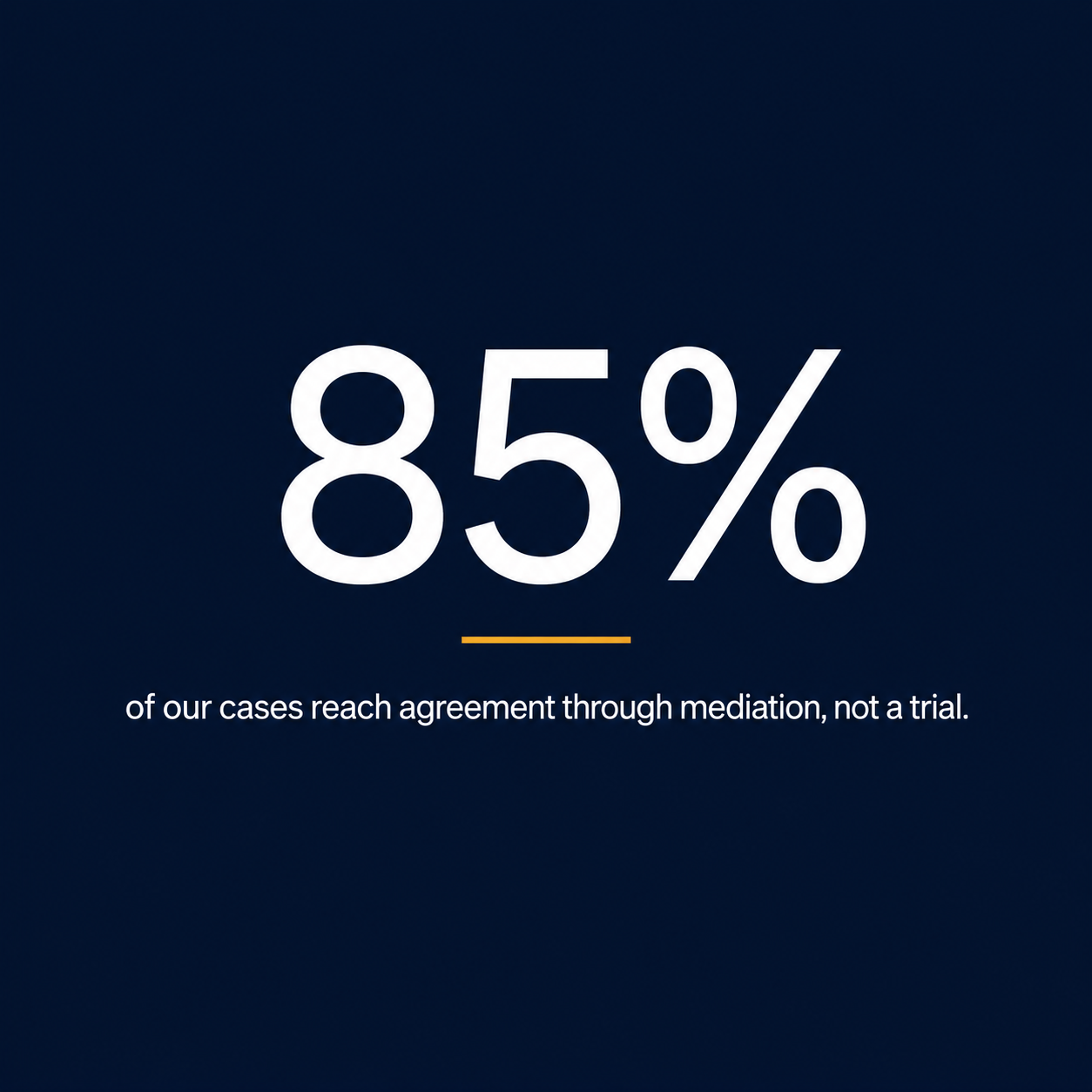
At Rosen Law Firm, we represent clients in mediation throughout the Raleigh-Durham Triangle, and about 85% of our cases reach agreement through mediation rather than a trial. We do not serve as the mediator ourselves. We sit beside you, prepare you for the process, and help you vet and choose the right mediator for your situation. The guidance below comes from that experience.
Can You Choose Your Own Divorce Mediator in North Carolina?
North Carolina handles divorce mediation in three different settings, and your ability to choose the mediator depends on which one applies to your case.
| Type of mediation | What it covers | Who picks the mediator | Cost | Attorneys present |
|---|---|---|---|---|
| Court custody mediation (Child Custody and Visitation Mediation Program) | Custody and visitation only | The court assigns one | Free to the parties | No |
| Family financial mediation (mediated settlement conference) | Property division, alimony, and support | You and your spouse select one, or the court appoints a certified mediator if you cannot agree | Usually split 50/50 | Yes, attendance is required |
| Private, voluntary mediation | Any issues you both agree to address | You choose fully | You pay the mediator’s private rate | Optional |
In a contested custody case, North Carolina refers parents to the Child Custody and Visitation Mediation Program after the case is filed. Parents attend an orientation and then a mediation session, and the state pays for it. The court provides the mediator, so this is the one setting where you do not get to choose.
Family financial mediation is different. When a divorce involves unresolved property division, alimony, or support, North Carolina requires a mediated settlement conference. Here, you and your spouse can name a certified mediator by agreement using a Designation of Mediator form (AOC-CV-825). If you cannot agree, the court appoints a certified mediator from its roster. This is where the financial questions get decided, including equitable distribution and alimony, so the mediator you choose matters most in these cases.
Private, voluntary mediation happens outside the court ordered programs. You can hire a mediator at any point, including before anything is filed, to work through your issues and reach a Separation agreement. You have full choice of mediator, and you and your spouse agree on who to use. Our page on mediation and collaborative divorce walks through how these out-of-court options fit together.
What Does It Mean for a Divorce Mediator to Be Certified in North Carolina?
A certified family financial mediator has been approved by the North Carolina Dispute Resolution Commission, which sets the standard for mediators used in the court’s family financial program. Certification tells you the mediator has met the state’s minimum training, experience, and ethics requirements.
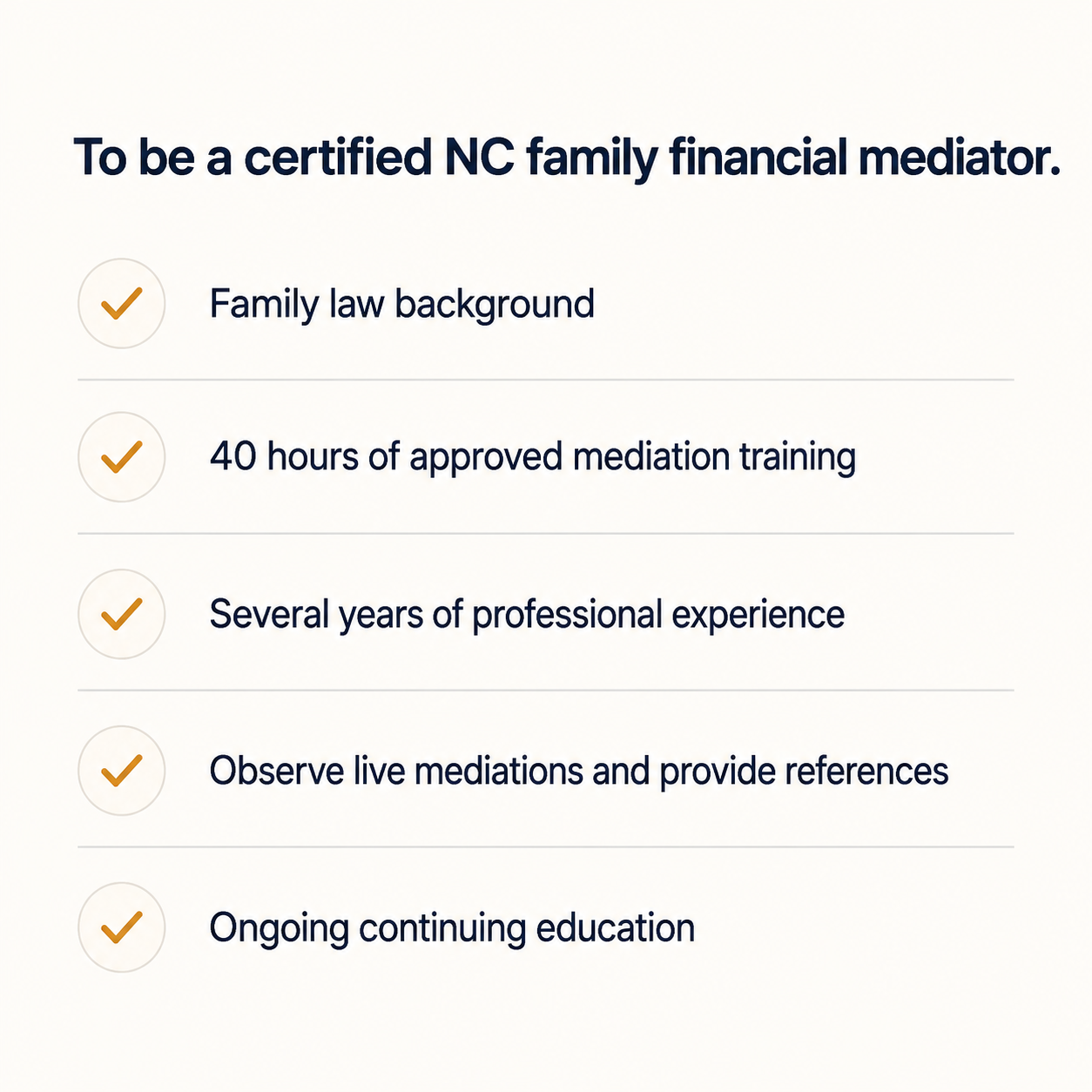
To be certified, a family financial mediator generally must have a family law background, complete an approved 40-hour family and divorce mediation training, and hold several years of professional experience in a qualifying field such as law, mental health, or accounting. Applicants also observe live mediations conducted by certified mediators, show they understand North Carolina’s mediation rules, and provide character references. Certified mediators complete continuing education to keep their certification.
Certification is required for the court’s family financial program. In private mediation, you will not be required to use a certified mediator, but choosing one is a good way to confirm the person has real training and is held to the state’s standards.
What to Look for in a Divorce Mediator
Next, focus on whether the mediator fits your case. The factors that matter most:
- Family law experience. Look for a mediator who works in divorce and family matters regularly. Ask how many divorce or custody cases they have handled and whether they see issues like yours often.
- The right focus for your issues. Some mediators concentrate on financial matters, others on parenting and custody, and some handle both. A high-conflict custody dispute and a complex property division often call for different strengths, so match the mediator to what your case needs.
- Mediation style. Mediators tend to be facilitative, meaning they guide the conversation without giving opinions, or evaluative, meaning they may offer a view on how a court might rule. Neither is better in every case. Ask which approach a mediator uses and pick the one that suits how you and your spouse work through problems.
- Neutrality and rapport. A mediator has to stay neutral and keep the discussion balanced. You should feel that the person can treat both you and your spouse fairly. If safety, abuse, or mental health concerns are part of your case, confirm the mediator is trained to handle them.
- Fees and logistics. Ask how the mediator charges, whether they require a retainer, how many sessions your case is likely to take, and whether sessions are in person or online. Confirm cancellation and postponement policies before you start.
- What happens when you reach an agreement? Find out whether the mediator will draft the settlement agreement or a memorandum of understanding, or whether you will need an attorney to finalize the documents. Non-attorney mediators often provide only a summary, and an enforceable agreement usually needs a lawyer to prepare it.
Questions to Ask a Divorce Mediator Before You Hire One
A short conversation tells you a lot. Before you hire a mediator, ask:
- How many family law cases have you mediated, and are you certified by the North Carolina Dispute Resolution Commission?
- Do you handle both custody and financial issues, or only one of them?
- Is your style facilitative or evaluative, and how do you handle an impasse or a high-conflict moment?
- How many sessions do most cases take, and over what time frame?
- What are your fees, do you require a retainer, and what extra costs should I expect?
- Will you draft the final agreement, and do you help with filing the court paperwork?
- Are our discussions confidential and protected from being used in court?
- Do you meet with both of us together, separately, or a mix of the two?
The answers help you compare mediators and confirm the person’s skills and approach fit your case. If you already have an attorney, our guide on reaching an agreement in a successful mediation covers how to prepare once you have chosen someone.
How Much Does Divorce Mediation Cost in North Carolina?
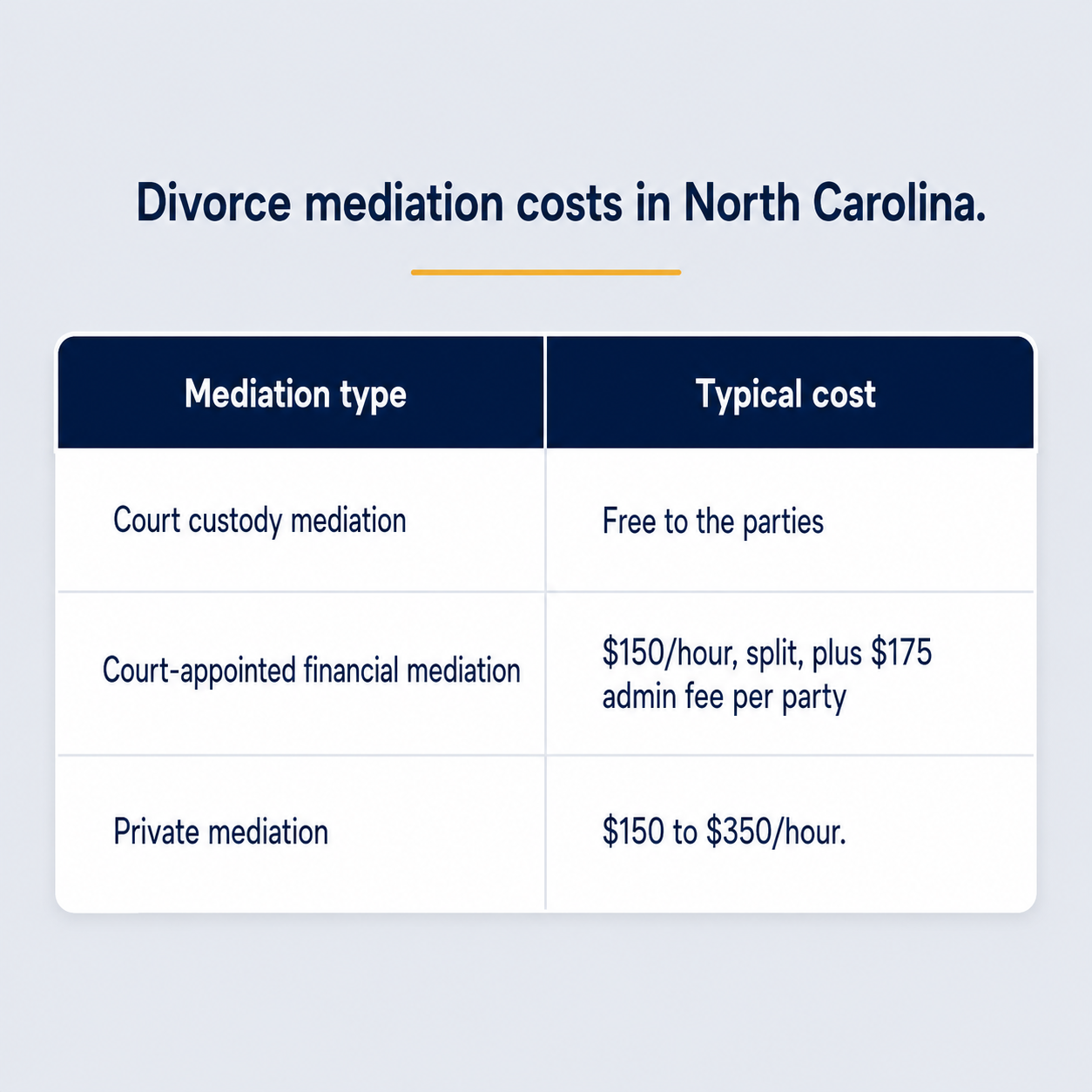
Cost depends on which type of mediation applies. Court-ordered custody mediation is free to the parties, because the state covers it.
For a court-appointed family financial mediator, North Carolina sets the rate at $150 per hour, which the parties split, plus a one-time administrative fee of $175 per party. If a session is postponed, an additional fee may apply depending on how much notice is given.
Private mediators set their own rates. In North Carolina, family mediators commonly charge somewhere around $150 to $350 per hour, with attorney-mediators often at the higher end. Sessions frequently run two to four hours, and many cases take more than one session. Total cost depends on how many sessions you need and how complex your case is. North Carolina does not publish a statewide average, but mediation almost always costs far less than a contested trial, which is a big reason we encourage it when it is a fit.
Where to Find a Divorce Mediator in North Carolina
A few reliable places to start:
- The North Carolina Judicial Branch. The state’s Find a Mediator tool lets you search certified mediators by program and area, including family financial mediators.
- The North Carolina Association of Professional Family Mediators. The NCAPFM offers a public Find a Mediator directory organized by city and county. It is a helpful starting point, though it does not independently verify each mediator’s qualifications.
- Referrals from professionals you trust. Family law attorneys and therapists often know mediators and can point you to someone with a strong track record. A firm led by a North Carolina Board-Certified Family Law Specialist can usually recommend mediators it has worked with and knows well.
When Divorce Mediation May Not Be the Right Choice
Mediation works when both spouses can negotiate safely and on reasonably even footing. That is not every situation. If there has been domestic violence or you have concerns for your safety, North Carolina allows the court to excuse you from mandatory mediation for good cause. High-conflict circumstances, active substance abuse, or a spouse who will not participate honestly can also make joint mediation a poor fit, and a different path may protect you better.
Mediation can accomplish a lot, but it does have a few limits worth knowing about. Certain issues cannot be resolved through an agreement alone, and even after you and your spouse reach a settlement, dividing some retirement accounts still calls for a separate court order known as a QDRO (Qualified Domestic Relations Order). If you find yourself wondering whether mediation is the right fit for your situation, that is exactly the kind of question worth raising early with an attorney, who can look closely at the specifics of your case and help you decide how best to move forward.
How We Help With Mediation at Rosen Law Firm
We are strong proponents of resolving divorce out of court, and we have spent more than 30 years helping people in the Triangle do exactly that. Because we represent clients in mediation rather than acting as the mediator, our job is to prepare you, protect your interests, and help you choose a mediator who fits your case. We work on a fixed fee set up front, so you know your cost from the start instead of watching an hourly bill climb.
If you are weighing mediation or trying to decide who should sit in the mediator’s chair, we can help you think it through. Take the next step and schedule a consultation, and we will give you a clear read on your options and what comes next.

Lisa is a leading figure in North Carolina’s family law field, dedicated to guiding clients through challenging times with compassion and expertise. As the President and Owner of Rosen Law Firm, P.A., Lisa has built a successful practice specializing in divorce, child custody, child support, alimony, equitable distribution, and domestic violence. She has been a North Carolina Board-Certified Specialist in Family Law since 1998.