

A divorce mediator and a divorce lawyer do two different jobs in North Carolina, and most separations here involve both. A mediator is a neutral who helps you and your spouse talk through terms, and who cannot give either of you legal advice or represent either of you. A lawyer works for one spouse, tells that spouse what the law entitles them to and what a proposed deal would cost them, and prepares the separation agreement that resolves custody, support, and property.
At Rosen Law Firm we represent clients in mediation. We are not the mediator, and we never sit in the middle. We favor out-of-court resolution wherever it is possible, and for many matters we encourage spouses to try to reach terms at the kitchen table first and then have us draft or review the agreement. At least half of our consultations are with people who arrive believing they can handle the whole thing themselves. Some of them can. The question worth answering before you pay either professional is which parts of your situation need a neutral and which parts need someone on your side.
Divorce Mediator vs. Lawyer: What Each One Actually Does
| Divorce mediator | Divorce lawyer | |
|---|---|---|
| Whose side they are on | Neither. The mediator is neutral | Yours only |
| Can give you legal advice | No | Yes |
| Can advise you on whether a deal protects your rights | No | Yes |
| Can prepare your separation agreement | No, though the mediator can help put agreed terms in writing | Yes, for the spouse the lawyer represents |
| Can decide the outcome | No | No. A judge or an arbitrator does that |
| Can compel financial disclosure | No | Yes, through discovery once a case is filed |
| What you are paying for | Facilitated conversation and a structured session | Advice, negotiation, drafting, and follow-through |
The short version is that a mediator improves the conversation and a lawyer protects one person inside it. Those are complementary jobs, which is why the two patterns we see most often are mediating first and then having a lawyer draft the agreement, or hiring a lawyer first and mediating with that lawyer at the table.
What a North Carolina Mediator Can and Cannot Do
North Carolina regulates the neutral role directly. Under the Standards of Professional Conduct for Mediators codified by the North Carolina Supreme Court, Standard 6 requires a mediator to limit the role solely to mediation and prohibits giving legal or other professional advice during the mediation. Standard 5 protects each party’s right to decide for themselves, so a mediator may suggest options but may not impose an opinion or decide anything.
A mediator can:
- Run the session and keep both spouses talking productively
- Raise questions about a proposal and suggest options neither of you thought of
- Meet with each spouse separately during the session
- Help write down the terms the two of you accept
- Tell you both to get legal, financial, or tax advice, which Standard 4(d) requires in appropriate circumstances
- Stop the mediation if continuing looks likely to produce a grossly unjust result
A mediator cannot:

- Give you legal advice about whether the proposed retirement split, alimony waiver, or home equity number protects your rights
- Represent either spouse
- Order anyone to produce a bank statement, a business record, or a stock plan document
- Decide anything
There is one narrow exception worth understanding. Standard 5(c) allows a mediator to share an opinion on the merits or on a settlement proposal as a last resort, and only if a party asks for it, after the mediator has first helped that party work through the question using their own resources. That is not legal advice and it is not advocacy. No one in the room is assessing the deal from your side of the table.
Even a mediator who is a licensed attorney stays on the neutral side of that line. Rule 2.4(b) of the North Carolina Rules of Professional Conduct requires a lawyer serving as a third-party neutral to tell unrepresented parties that the lawyer is not representing them, and to explain the difference between a neutral and an advocate when a party does not appear to understand it.
Does a Divorce Mediator in North Carolina Have to Be a Lawyer?
No. Under Rule 8 of the family financial settlement rules, a candidate for certification as a District Court Family Financial mediator may qualify as a lawyer with at least five years of experience, or through one of several nonlawyer paths. Eligible nonlawyers include licensed psychiatrists, psychologists, marriage and family therapists, clinical social workers, and licensed professional counselors, each with at least five years in the field, along with accountants certified in North Carolina and holders of the Association for Conflict Resolution’s Family Mediator Advanced Practitioner designation who have an undergraduate degree. Applicants who are not licensed to practice law in a U.S. state complete additional training in North Carolina legal terminology, court structure, and civil procedure.
The rules also direct courts to appoint mediators without regard to whether the mediator is a licensed attorney. Certification through the North Carolina Dispute Resolution Commission is a qualification to serve in the court programs, not a license to advise you.
Ask any mediator you are considering whether they are certified for the program your case sits in, how much family financial work they have done, and how they handle a session where one spouse knows far more about the money than the other.
Private Mediation vs. Court-Ordered Mediation in North Carolina
People use “mediation” to mean several different things here, and the answer to “do I need a lawyer” changes depending on which one you are in. There is private mediation the two of you arrange yourselves, and there are two separate court programs.
| Private mediation | Court custody mediation | Family Financial Settlement Program | |
|---|---|---|---|
| When it happens | Any time, including before anyone files | After a custody claim is filed | After an equitable distribution claim is filed |
| Who arranges it | The spouses | The court | The court, or the parties by agreement |
| What it covers | Whatever the spouses put on the table | Custody and visitation only | Property division, and alimony, postseparation support, and child support |
| Mediator cost to you | Whatever you agree with the mediator | No charge | Set by rule for a court-appointed mediator, or by agreement |
| What it produces | Agreed terms, usually written up as a summary | A parenting agreement submitted to the judge | Agreed terms, or an executed agreement if the formalities are completed |
Private mediation
Private mediation is voluntary and contractual. You and your spouse pick the neutral, decide the scope, agree on the fee, and can do it months before anyone files anything. A private mediator has no judicial authority. The mediator cannot compel a settlement, order discovery, or issue an award. If a case is already pending, a privately selected mediator can satisfy the court’s financial mediation requirement, but only if that mediator is certified under the court’s rules and the designation is filed with the court.
Court-ordered custody mediation
North Carolina has established a Child Custody and Visitation Mediation Program under N.C. Gen. Stat. § 7A-494, which operates in judicial districts across the state and is implemented through N.C. Gen. Stat. § 50-13.1. Under § 50-13.1(b), contested custody and visitation issues are set for mediation before or alongside the setting of the matter for hearing, unless the court waives it. The courts provide custody mediation free of charge. Parents attend an orientation class and then a mediation session, and if they reach agreement, the mediator prepares a written parenting agreement for the parties and a judge to sign.
The same statute draws a hard line around what this program covers. Section 50-13.1(b) states that alimony, child support, and other economic issues may not be referred to mediation under it. This program resolves parenting, not money. That is why a parent can accurately say that mediation was free and still need a lawyer for the entire financial side of the separation. If you want the wider picture on how custody is decided in this state, our child custody section covers it.
Under § 50-13.1(g), a parenting agreement reached in the program goes to the court, and unless the judge finds good reason not to, it is incorporated into an order and becomes enforceable as one.
The Family Financial Settlement Program
Equitable distribution cases run through a different system, created by N.C. Gen. Stat. § 7A-38.4A and the Supreme Court’s Rules for Settlement Procedures in District Court Family Financial Cases. The scheduling order in an equitable distribution case must require the parties and their lawyers to attend a mediated settlement conference, or another settlement procedure the parties agree on, unless the court excuses the case for good cause. A mediated settlement conference is the default whenever the parties have not agreed on the procedure, the neutral, and the neutral’s compensation. The alternatives the rules authorize are neutral evaluation and, where local rules allow it, a judicial settlement conference. Agreeing to arbitrate under the Family Law Arbitration Act is treated as good cause for the court to dispense with these procedures altogether.
This program can also take in alimony, postseparation support, and child support. Custody comes into a family financial conference only by agreement of all parties and the mediator, and only after the custody mediation requirement has been met or waived. The North Carolina Judicial Branch’s program page puts the point about the neutral plainly: a mediator cannot give legal advice to anyone participating in the conference.
One point gets missed constantly. The court can require you to show up and participate. No one can require you to make an offer or accept one. Our page on property division in North Carolina walks through what is actually on the table in those sessions.
What Happens to the Agreement You Reach in Mediation
This is the part that costs people money when they get it wrong.
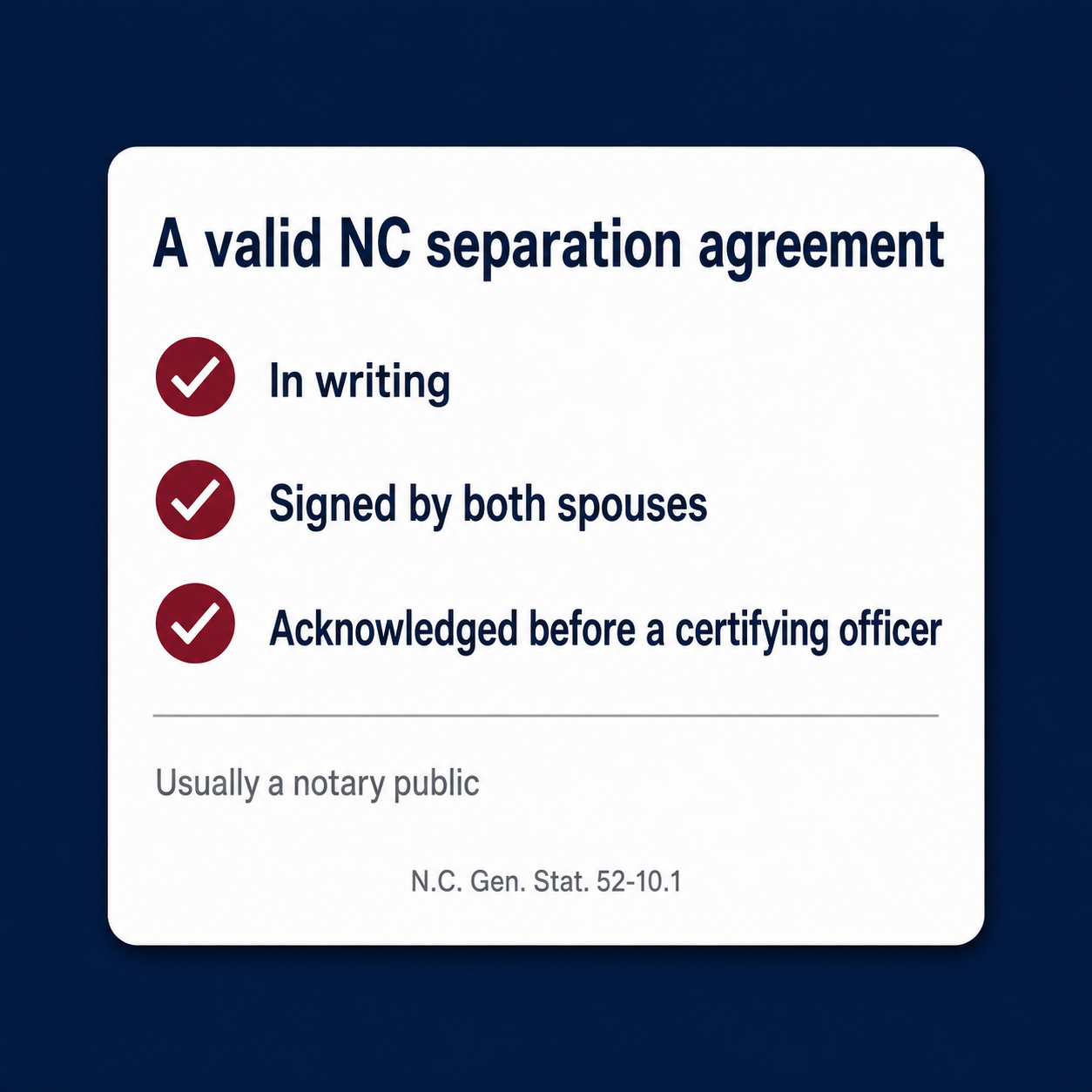
What usually comes out of a private mediation is a set of agreed terms, a memorandum of understanding, or a settlement summary. That document is often not the binding contract. A separation agreement in North Carolina is legal, valid, and binding only if it is in writing and acknowledged by both parties before a certifying officer, under N.C. Gen. Stat. § 52-10.1. A certifying officer is a notary public or a judge, magistrate, or clerk of the General Court of Justice, and cannot be a party to the contract. In practice that means both signatures and both acknowledgments in front of a notary. Terms agreed by email, a mediator’s notes, and an unsigned term sheet do not satisfy that requirement.
Property settlements carry the same formality. Under § 50-20(d), spouses may provide for the distribution of marital or divisible property by written agreement, executed and acknowledged the same way, and the family financial rules mirror that requirement. Session Law 2025-25 also rewrote N.C. Gen. Stat. § 39-13.3 effective October 1, 2025, so that a conveyance between spouses does not waive a claim to equitable distribution in the property conveyed, and an equitable distribution claim cannot be waived or released in the deed itself. Signing a deed does not settle your property claims.
There is also a limit on who can write the document. Preparing a legal document for another person falls within North Carolina’s definition of practicing law under N.C. Gen. Stat. § 84-2.1. The North Carolina State Bar addressed the mediator version of this question in 2012 Formal Ethics Opinion 2, which concluded that a lawyer-mediator could not draft the final contract for two unrepresented mediation participants, because doing so would put the lawyer in an impermissible joint representation. That opinion involved a business contract, and the same conflict analysis applies to a separation agreement, where two spouses have legally adverse interests even when they agree on the outline of a deal.
So the sequence that works looks like this:
- You and your spouse agree on terms, at the kitchen table or in mediation.
- The mediator writes those terms up as a summary.
- A lawyer representing one spouse drafts the separation agreement, and the other spouse has it independently reviewed.
- Both spouses sign and acknowledge it before a notary.
- The implementation documents get prepared: a deed, a qualified domestic relations order for retirement, stock transfer provisions, releases, indemnities, and security for any deferred payments.
In court-connected family financial mediation, steps three and four can happen at or shortly after the conference, because both spouses usually have counsel there. If the parties settle all property terms and do not intend to submit the agreement to the court for approval, Rule 4(c) of the family financial rules requires that agreement to be signed by all parties and formally acknowledged as § 50-20(d) demands. An unapproved property agreement that has not been signed and acknowledged is not enforceable. If the parties cannot finish the document at the session, the rules call for a written summary to guide the drafting that follows.
If you want to see what a finished document looks like before you negotiate anything, we publish a sample separation agreement and an article on breach and enforcement of separation agreements.
How you enforce the agreement later
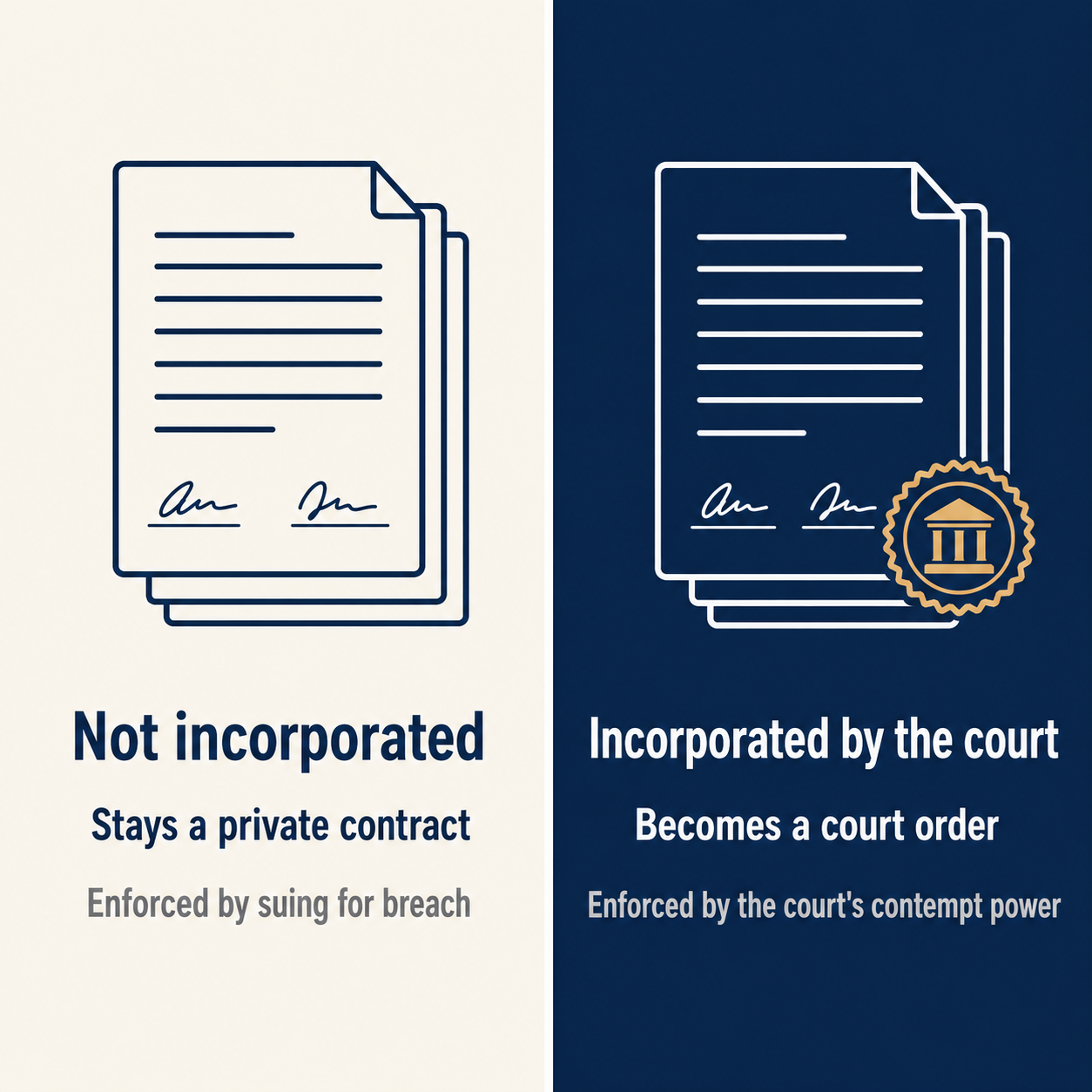
An unincorporated separation agreement is a contract, enforced and modified under ordinary contract principles. If your spouse stops paying, your remedy is a lawsuit for breach, including specific performance where that fits. Once a court approves the agreement and enters it as a judgment, the picture changes. In Walters v. Walters, 307 N.C. 381, 386, 298 S.E.2d 338, 342 (1983), the North Carolina Supreme Court held that separation agreements approved by the court as judgments are treated as court-ordered judgments, which are modifiable and enforceable through the court’s contempt power in the same manner as any other judgment in a domestic relations case. Custody and support terms also stay subject to the court’s continuing authority and the applicable modification standards, whether or not the parents once agreed to them.
The divorce itself does not settle anything
Under N.C. Gen. Stat. § 50-6, you can obtain an absolute divorce after one year of living separate and apart, if either spouse has resided in North Carolina for six months. That judgment ends the marriage. It does not divide anything.
North Carolina County Courthouse Information
| County | Address | Hours |
|---|---|---|
| Wake County | 316 Fayetteville St Raleigh NC 27601 | Monday: 8:30am-5:00pm Tuesday: 8:30am-5:00pm Wednesday: 8:30am-5:00pm Thursday: 8:30am-5:00pm Friday: 8:30am-5:00pm Saturday: Closed Sunday: Closed |
| Durham County | 510 S Dillard St Durham, NC 27701 | Monday: 8:30am-5:00pm Tuesday: 8:30am-5:00pm Wednesday: 8:30am-5:00pm Thursday: 8:30am-5:00pm Friday: 8:30am-5:00pm Saturday: Closed Sunday: Closed |
| Chatham County | 40 E Chatham St Pittsboro, NC 27312 | Monday: 8:30am-5:00pm Tuesday: 8:30am-5:00pm Wednesday: 8:30am-5:00pm Thursday: 8:30am-5:00pm Friday: 8:30am-5:00pm Saturday: Closed Sunday: Closed |
| Johnston County | 207 E Johnston St #209 Smithfield, NC 27577 | Monday: 8:00am-5:00pm Tuesday: 8:00am-5:00pm Wednesday: 8:00am-5:00pm Thursday: 8:00am-5:00pm Friday: 8:00am-5:00pm Saturday: Closed Sunday: Closed |
| Orange County | 106 E Margaret Ln Hillsborough, NC 27278 | Monday: 8:30am-5:00pm Tuesday: 8:30am-5:00pm Wednesday: 8:30am-5:00pm Thursday: 8:30am-5:00pm Friday: 8:30am-5:00pm Saturday: Closed Sunday: Closed |
It can also close doors, in both directions. An absolute divorce judgment can cut off equitable distribution and spousal support claims that were never asserted or resolved. And a separation agreement you already signed can bar those claims on its own. In Hagler v. Hagler, 319 N.C. 287, 290, 354 S.E.2d 228, 232 (1987), the Supreme Court held that an agreement which fully disposed of the parties’ property rights arising out of the marriage barred a later equitable distribution claim, describing the statutes as containing a mechanism for spouses to forego equitable distribution and decide for themselves how the marital estate will be divided. A broad release you sign at the end of a mediation can do exactly that. Reading it that way, before you sign, is legal work.
Where a Mediator and a Lawyer Fit on the Path to Resolution
We think about resolution as a continuum, from the most control you keep to the least:
- Kitchen table. The two of you work out terms directly. No neutral, no filings.
- Settlement negotiation. The spouses or their lawyers negotiate, still with no third-party neutral.
- Mediation. A neutral facilitates. No one decides for you.
- Arbitration. A neutral decides. N.C. Gen. Stat. § 50-41 makes it the policy of the state to allow spouses, by agreement of all parties, to arbitrate the issues arising from a marital separation or divorce, other than the divorce itself, while preserving the right to seek modification of alimony, child custody, and child support on a substantial change of circumstances.
- Court. A judge decides.
This is a way to understand your options, not a required order. You can move between processes, combine them, mediate before filing or after discovery, or come back to negotiation during trial preparation. Collaborative law sits alongside all of this under N.C. Gen. Stat. § 50-70 as a separate structured process in which each spouse has their own attorney and everyone signs a participation agreement. Collaborative divorce is not mediation, and it does not remove lawyers from the process.
We work through most matters on the top half of that list. Our mediation and collaborative divorce page explains how we handle each option, and if you are still deciding whether a session is worth scheduling, what mediation can do for you is a good next read.
When Mediation Alone Is Enough
Mediating without your own lawyer works best when all of the following are true:
- You and your spouse have roughly balanced information and bargaining ability
- Disclosure is complete and you can verify it
- The assets are uncomplicated
- No one is being pressured
- Nothing important is unresolved about support, taxes, retirement, a business, or how the deal gets implemented
Court custody mediation is the clearest example of mediation producing an enforceable result on its own, because the program exists to help parents reach a parenting agreement the judge can approve and incorporate.
There is a middle option that most people do not know about. North Carolina State Bar ethics guidance permits a lawyer to provide limited advice and drafting to someone who is otherwise handling their own matter. You can negotiate on your own or in mediation and buy a defined piece of legal work: one advice session, agreement review, or the drafting itself.
When Mediation Is Not the Right Choice
If there is abuse or you are afraid of your spouse
Domestic violence is a recognized reason to ask the court to waive custody mediation. Section 50-13.1(c) permits waiver for good cause, on the court’s own motion or on a party’s motion, and the statutory examples include undue hardship to a party, allegations of abuse or neglect of the child, allegations of alcoholism, drug abuse, or domestic violence between the parents, allegations of severe psychological, psychiatric, or emotional problems, and an agreement to use private mediation. A showing that a party lives more than fifty miles from the court may also be good cause.
The waiver is not automatic just because an allegation is made. You file a written motion asking the court to waive custody mediation, state the supporting facts, and get a ruling from the judge. The motion forms are on the North Carolina Judicial Branch forms page.
The financial side has its own protections. The family financial rules list an allegation of domestic violence as good cause for dispensing with the settlement procedure entirely, allow a conference to be held using remote technology, and let the court excuse a domestic violence victim from physically attending or participating.
Raise this before the scheduled session rather than simply not appearing. If safety is your first concern, start with our domestic violence resources, and call us before you agree to sit in a room with your spouse.
If you suspect your spouse is hiding money
A mediator has no power to make anyone produce documents. There are no subpoenas, no document requests, no depositions, and no ruling that disclosure is complete. Settling before you know what exists is how people give away assets they never saw.
Warning signs worth taking seriously:
- One spouse controls all account access and passwords
- Transfers you cannot explain
- Business records that are incomplete or unavailable
- A compensation plan you have never seen, including bonuses, restricted stock, or options
- Tax returns that do not match what you were told
- Missing retirement statements
- Resistance to any valuation
None of this means mediation is off the table forever. It means the order changes. Discovery, tracing, valuation, or forensic work comes first, and the mediation happens once both spouses are working from the same numbers.
If the imbalance is too large
The mediator standards themselves identify the inability or unwillingness of a party to participate meaningfully, inequality of bargaining power or ability, unfairness resulting from nondisclosure or fraud, and other circumstances likely to lead to a grossly unjust result as signs that the integrity of the process has been compromised. Standard 5(e) requires a mediator who sees those conditions to tell the parties, and permits the mediator to end the mediation. If that sounds like your marriage, get your own advice before you negotiate. Keeping conflict low is still a reasonable goal, and you can pursue it from a position where you know what you are agreeing to.
What a Mediator and a Lawyer Cost in North Carolina
Mediator cost depends on which system you are in.
- Court-appointed family financial mediator. Rule 7 of the family financial rules sets compensation at $150 per hour, plus a one-time administrative fee of $175 per case that accrues when the mediator is appointed. The mediator’s fee is paid in equal shares by the spouses unless they agree otherwise or the court orders otherwise. A party the court finds unable to pay a full share is not required to, and the court may order one or more shares paid out of the marital estate.
- A mediator you choose yourselves. The rate is whatever the mediator and the parties agree on. North Carolina does not set a statewide private rate, and rates vary with the mediator’s background, session format, preparation, and the number of participants.
- Court custody mediation. No charge to the parents.
Before you book a private mediator, ask in writing for the hourly rate, any minimum session charge, the preparation charge, the postponement or cancellation policy, any administrative fee, and how the cost is split between the two of you.
Legal fees cover a wider scope than one session. You are paying for advice about your own position, a review of what your spouse has disclosed, negotiation, the drafting of the agreement and the documents that implement it, and a plan for what happens if the agreement is broken.
We set a fixed fee up front, so you know your cost before the work starts instead of watching an hourly bill grow. If the reason you are considering mediating alone is that an open-ended legal bill sounds worse than an imperfect deal, that is the fear the fixed fee is meant to remove. Our attorney fee calculator gives you a range based on your situation. For a quote on your matter, contact us.
Common Questions About Mediators and Lawyers in North Carolina
Can a mediator write my separation agreement?
Not as your final, binding agreement. A mediator can help put the terms you both accepted into a written summary. Preparing the separation agreement itself is legal work performed for one spouse, and the State Bar has said a lawyer-mediator cannot take on that job for two unrepresented participants.
Do I need a lawyer for court-ordered custody mediation?
Not for the session itself. The court custody program is designed for parents and the mediator’s services are free. A lawyer matters for everything the program cannot touch, which under § 50-13.1(b) includes alimony, child support, and every other economic issue.
Can a judge force me to settle in mediation?
No. The court can order you to attend and participate in a settlement procedure. No rule requires you to make an offer or to accept one.
What happens if my spouse violates our agreement?
It depends on whether the agreement stayed a private contract or was incorporated into a court order. An unincorporated agreement is enforced by suing for breach of contract. An incorporated agreement can be enforced through the court’s contempt power and like any other judgment.
Is collaborative divorce the same as mediation?
No. In collaborative divorce, each spouse has their own attorney and everyone signs an agreement to use collaborative procedures. There is no neutral facilitating between the two of you the way a mediator does, and both lawyers are advocates for their own client.
Do we still need a divorce if we sign a separation agreement?
Yes. The separation agreement resolves custody, support, and property. The absolute divorce ends the marriage, and you can file for it after one year of separation, provided the residency requirement is met.
How to Decide Whether You Need a Mediator, a Lawyer, or Both
If you are trying to decide between a mediator and a lawyer, what you are really deciding is whether anything in your situation needs someone looking out for you specifically. Most people can answer that in one conversation. Bring us the facts, and we will tell you whether we think mediation gets you most of the way there, what we would want written into a formal agreement, and what your matter would cost, with a fixed fee set up front.
Lisa Angel is a North Carolina Board-Certified Family Law Specialist and has practiced exclusively in North Carolina family law for more than 30 years. We serve Wake, Durham, and Orange counties, plus Johnston, and we can help with non-litigation matters anywhere in North Carolina. Most consultations happen by Zoom.
Take the next step and schedule your consultation. If mediation looks like the right path, how to reach an agreement in a successful mediation is worth reading before your session.
This article is general information about North Carolina law and is not legal advice. Outcomes depend on the specific facts of each case.

Lisa is a leading figure in North Carolina’s family law field, dedicated to guiding clients through challenging times with compassion and expertise. As the President and Owner of Rosen Law Firm, P.A., Lisa has built a successful practice specializing in divorce, child custody, child support, alimony, equitable distribution, and domestic violence. She has been a North Carolina Board-Certified Specialist in Family Law since 1998.