

Read the support paragraph before you sign it. In North Carolina a waiver only counts if it is express.
Yes, you can waive spousal support in North Carolina, and the law is specific about how. The waiver has to sit inside a premarital agreement, a separation agreement, or a written contract the two of you sign while you are separated. It has to make clear that spousal support is the thing being given up. A paragraph saying the two of you release each other from all claims does not do it, even though it sounds like it should.
If a draft agreement just landed in your inbox, nothing has happened yet. You are not bound by a document you have not signed, and the deadline that actually ends a spousal support claim is the absolute divorce, which cannot happen until you and your spouse have been separated for a full year. You have time to get this right.
Rosen Law Firm has handled North Carolina separations and divorces since 1990, and the problem we see most often is not a waiver somebody regretted signing. It is a person who never waived anything and lost the right to alimony anyway, because the divorce was finalized before an alimony claim was filed. Giving support up on purpose and losing it by accident are two different things with two different rules, and this article covers both.
What spousal support means in a North Carolina case
North Carolina splits spousal support into two payments that cover different stretches of time, and a third right travels with them. One waiver can give up all three.
| The right | What it is | When it applies |
| Postseparation support | Temporary support paid by one spouse to the other. | From separation until the alimony question is decided or dropped. |
| Alimony | Longer term support, paid either in regular installments or as one lump sum. | A court can order it while you are still married or after the divorce. |
| Attorney fees | The supporting spouse can be ordered to pay the dependent spouse’s legal fees. | Decided as part of the support case. |
Only a dependent spouse can receive support. N.C. Gen. Stat. § 50-16.1A(2) defines a dependent spouse as one who is actually substantially dependent on the other spouse for support, or who is substantially in need of support from them. In everyday terms, the question is whether you can cover your reasonable expenses out of your own income and assets. If you cannot, and your spouse can help, you are likely the dependent spouse and a waiver would cost you something real. If you both support yourselves comfortably, a waiver may cost you nothing at all, and people in that position often sign one anyway so that neither of them can raise the subject later. Our alimony and postseparation support overview explains how each type of support is decided when nobody waives anything.
Which agreements can waive spousal support
N.C. Gen. Stat. § 50-16.6(b) is the statute that allows a waiver, and it sets two conditions. The provision has to be express, which the courts read strictly and which the next section explains. And the bar lasts only “so long as the agreement is performed,” meaning both of you actually do what the agreement promises. A waiver stops protecting the spouse who relies on it if that spouse stops doing what the agreement requires of them.
The same statute names the only three documents that can carry the waiver.
| Agreement | When you sign it | What makes it valid | Notes |
| Premarital agreement | Before the wedding. It takes effect when you marry. | In writing and signed by both of you. Nothing has to be exchanged for it. | State law says outright that a premarital agreement may modify or eliminate spousal support. |
| Separation agreement | When you separate, or as you are separating. | In writing, signed by both of you, and acknowledged before a notary or other certifying officer. | In our practice this is where most waivers turn up, since a separation agreement is where support, property, and custody get settled together. |
| Written contract made during a separation | While you are already living separate and apart. | In writing, with the waiver clearly stated, acknowledged by both of you before a certifying officer. | Built for couples who may reconcile. A waiver here survives a reconciliation and a later separation. |
For premarital agreements, N.C. Gen. Stat. § 52B-4(a)(4) says in plain words that the parties may contract about the modification or elimination of spousal support. The express requirement still applies. A prenup that says nothing about support, and never points at the statutes that create it, has not waived it any more than a separation agreement would have.
If you are working on a separation agreement, our guide on how to draft a separation agreement covers the other terms that belong in it.
A postnuptial agreement signed while you are living together cannot waive alimony
Married couples can contract with each other about many things, including how they own and divide property. Spousal support is the exception. North Carolina will not enforce an agreement that lets one spouse walk away from the duty of support when the couple is living together and not planning to separate. A waiver has to be part of a separation agreement, or part of a contract signed during a period of separation.
That second option is the reason the third row exists in the table above. In 2013 the legislature added N.C. Gen. Stat. § 52-10(a1), which lets separated spouses sign a written support waiver that stays valid even if they reconcile and separate again later. Before 2013, North Carolina would not enforce an agreement in which reconciling spouses set support terms for a future separation. Our page on post-marital agreements in North Carolina covers what these agreements can and cannot do.
What an express waiver has to say
The statute requires an express provision, and North Carolina courts read that word narrowly. The provision has to make clear that spousal support is the thing being given up. A broad release of claims in general does not reach it.
That is what happened in Napier v. Napier, 135 N.C. App. 364, 520 S.E.2d 312 (1999). The couple signed a property agreement in which each spouse released the other from “all causes of action, claims, rights or demands whatsoever.” The husband later argued that this wiped out his wife’s alimony claim. The Court of Appeals held that it did not. The release never used the word alimony or anything equivalent, and the agreement cited the property division statute, which told the court the couple had intended to settle property and nothing else.
Using the word alimony is not the only way to be express, though. In Stewart v. Stewart, 141 N.C. App. 236, 541 S.E.2d 209 (2000), a premarital agreement said each party waived, released and relinquished any right arising under several chapters of the General Statutes, one of which was Chapter 50. Chapter 50 is where alimony and postseparation support live. The Court of Appeals held that pointing at the chapter was express enough to waive both.
Read the two cases together and the test becomes practical. Does the document point at spousal support, either by name or by pointing at the law that creates it? Napier’s release pointed at everything in general and at the property statute in particular, so it did not waive alimony. Stewart’s pointed straight at the chapter that governs alimony, so it did.
If a waiver paragraph is in front of you right now, read it for these things:
- The word alimony, or spousal support, or a reference to Chapter 50 of the North Carolina General Statutes.
- Postseparation support. The clearest agreements name it separately, because it is a separate right covering a different stretch of time.
- Attorney fees, also named separately for the same reason.
- An operative verb attached to each. Waives, releases, relinquishes, or bars all do the job. A sentence saying only that the parties “have considered” support is not a waiver.
- Whether the waiver runs both ways or only against you.
If your paragraph releases claims in general and never points at support or at the statutes that create it, it probably has not waived your right to support. That is worth confirming with an attorney rather than assuming, because the rest of the document can matter, as it did in Napier.
Does silence in a separation agreement waive alimony?
No. An agreement that says nothing about alimony has not waived it.
People assume otherwise because silence works differently for property. If a separation agreement fully divides everything you own but never uses the phrase equitable distribution, North Carolina courts will generally treat the property question as closed. That is what the Supreme Court held in Hagler v. Hagler, 319 N.C. 287, 354 S.E.2d 228, 235 (1987), reading a comprehensive agreement as the couple’s intent to dispose fully of their property rights. Support is governed by a different statute with a stricter test, so the same silence does not carry over.
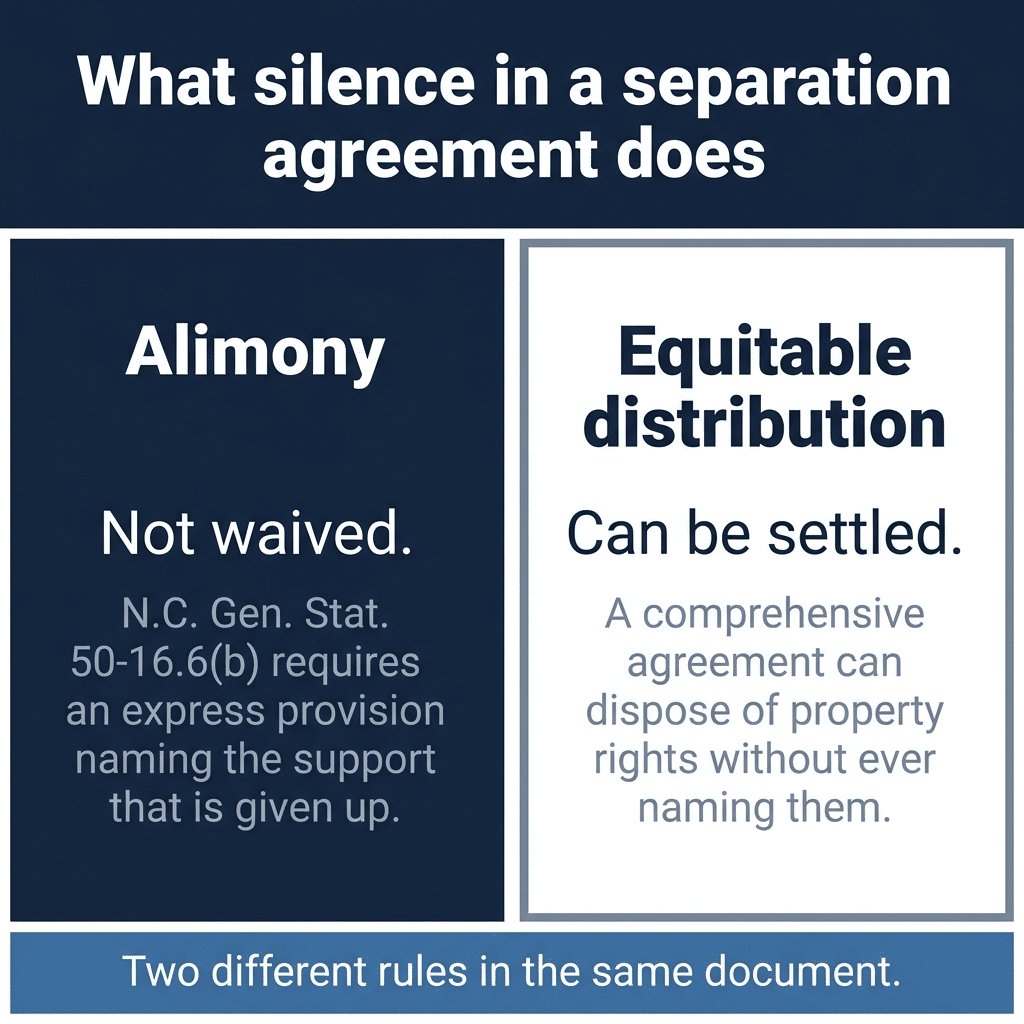
Silence does different work depending on which right you are looking at.
An agreement that divides your property and says nothing about alimony leaves your alimony claim open. What closes it is the divorce.
The absolute divorce is the deadline that ends the claim
An absolute divorce is the judgment that legally ends your marriage. Under N.C. Gen. Stat. § 50-6, either spouse can ask for one after you have lived separate and apart for a year, as long as one of you has lived in North Carolina for six months. It is the simplest step in the process, and that is why it catches people. It looks like paperwork.
Here is the rule. Once a judgment of absolute divorce is entered, you can no longer ask a court for alimony unless your alimony claim was already pending or already resolved at that moment. N.C. Gen. Stat. § 50-11(c) protects an alimony or postseparation support action that is pending when the divorce is granted, and it protects support already set out in an earlier court order. It does nothing for a claim that was never brought. If no alimony claim is pending on that date, any postseparation support you were receiving ends then too.
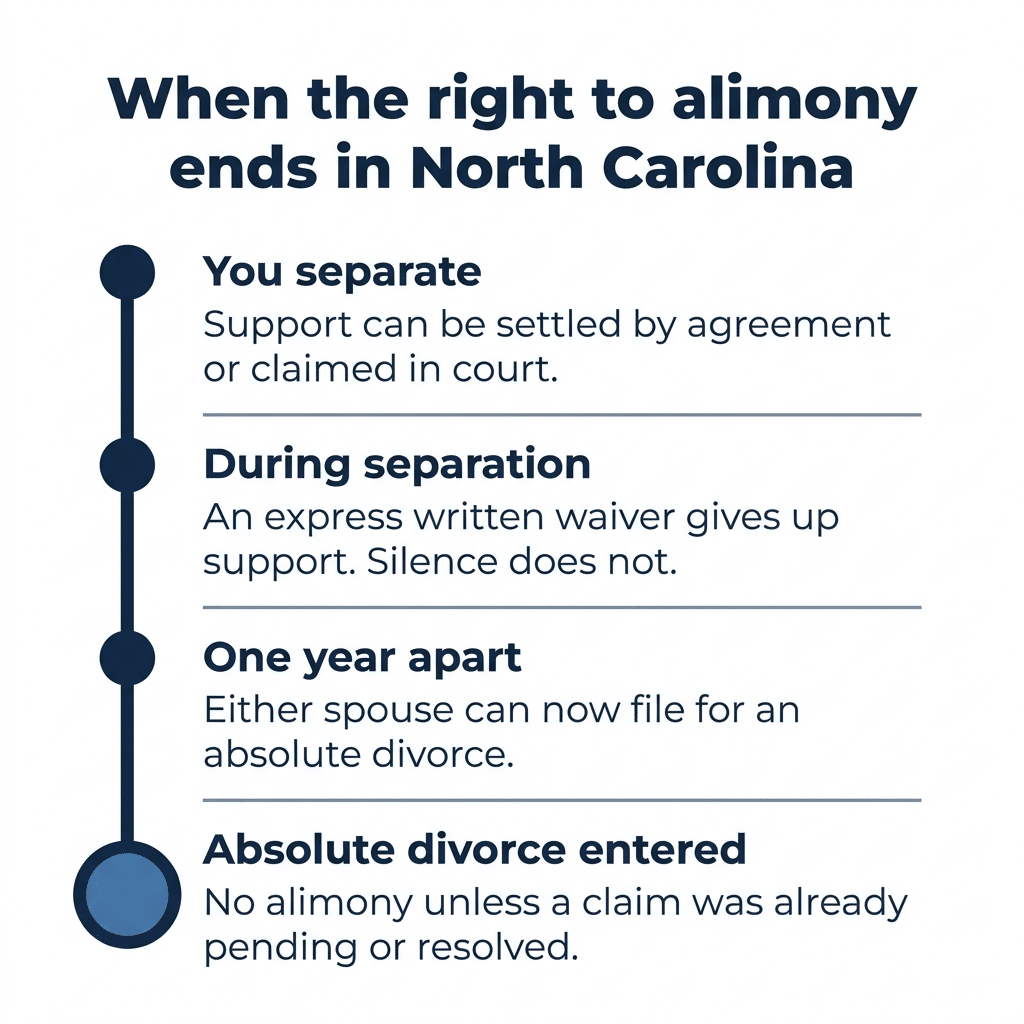
When the right to alimony ends in North Carolina.
Pending has a specific meaning here. A claim is pending when it has been filed with the district court as part of a lawsuit, either in a complaint you filed or as a counterclaim in a case your spouse started, and it has not been dismissed. Talking about alimony, negotiating over it, or writing it into a draft does not make a claim pending.
Two situations do not depend on filing anything, and they cover most people who settle:
North Carolina County Courthouse Information
| County | Address | Hours |
|---|---|---|
| Wake County | 316 Fayetteville St Raleigh NC 27601 | Monday: 8:30am-5:00pm Tuesday: 8:30am-5:00pm Wednesday: 8:30am-5:00pm Thursday: 8:30am-5:00pm Friday: 8:30am-5:00pm Saturday: Closed Sunday: Closed |
| Durham County | 510 S Dillard St Durham, NC 27701 | Monday: 8:30am-5:00pm Tuesday: 8:30am-5:00pm Wednesday: 8:30am-5:00pm Thursday: 8:30am-5:00pm Friday: 8:30am-5:00pm Saturday: Closed Sunday: Closed |
| Chatham County | 40 E Chatham St Pittsboro, NC 27312 | Monday: 8:30am-5:00pm Tuesday: 8:30am-5:00pm Wednesday: 8:30am-5:00pm Thursday: 8:30am-5:00pm Friday: 8:30am-5:00pm Saturday: Closed Sunday: Closed |
| Johnston County | 207 E Johnston St #209 Smithfield, NC 27577 | Monday: 8:00am-5:00pm Tuesday: 8:00am-5:00pm Wednesday: 8:00am-5:00pm Thursday: 8:00am-5:00pm Friday: 8:00am-5:00pm Saturday: Closed Sunday: Closed |
| Orange County | 106 E Margaret Ln Hillsborough, NC 27278 | Monday: 8:30am-5:00pm Tuesday: 8:30am-5:00pm Wednesday: 8:30am-5:00pm Thursday: 8:30am-5:00pm Friday: 8:30am-5:00pm Saturday: Closed Sunday: Closed |
- Your agreement promises you support. That promise is a contract between you and your spouse. It is enforced by suing for breach of contract, so it does not rise or fall with an alimony claim. Ask your attorney to confirm how yours is written, because an agreement that a judge incorporates into a court order is enforced differently.
- Your agreement waives support. There is nothing left to file, which is the point of the waiver.
The people who get hurt are in the middle: separated, still working things out, no agreement signed, no claim filed, and then a divorce complaint arrives and the year has already run. If that is close to your situation, deal with alimony before the divorce is filed, or make sure you file the claim as soon as you are served with the divorce. We answer the follow-up question, whether you can still file for alimony or equitable distribution after the divorce, separately.
How a waiver has to be signed
A separation agreement is not valid just because both people signed it. N.C. Gen. Stat. § 52-10.1 adds formalities, and missing one can undo the entire agreement, waiver included. Check your document for all of these:
- It is in writing. A spoken understanding about support is not enforceable, however clear it felt at the time.
- Both spouses signed it.
- Both signatures were acknowledged before a certifying officer. In almost every case that is a notary public, though a judge, magistrate, or clerk of court also qualifies.
- The certifying officer is not one of you. Your spouse cannot notarize your signature.
The acknowledgment matters more than it looks. A separation agreement that was never properly acknowledged is treated as void from the beginning, which means the waiver inside it never took effect either.
Premarital agreements are lighter. They have to be in writing and signed by both people, and nothing has to be exchanged for them. Many attorneys have them notarized anyway, so that nobody can argue later about whether a signature was genuine.
What can undo a waiver you already signed
A signed waiver is not always the end of the discussion. North Carolina recognizes several ways to challenge one, and each has its own requirements.
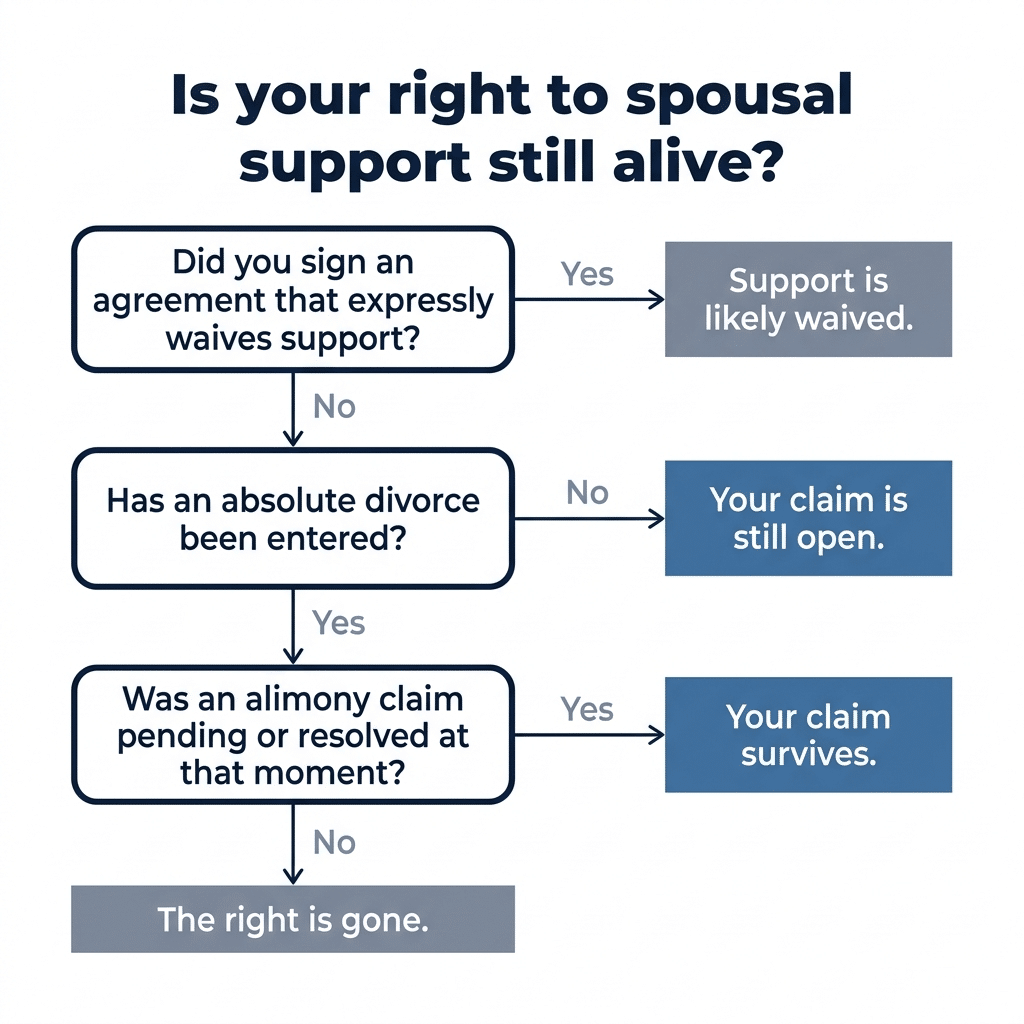
A quick way to work out whether your claim is still open.
- The agreement is not being performed. The bar on support in § 50-16.6(b) applies only so long as the agreement is performed. If you gave up support in exchange for payments, a transfer, or a refinance that your spouse has not carried out, the waiver is worth revisiting with an attorney.
- The agreement was not properly acknowledged. A separation agreement that failed the § 52-10.1 formalities is void from the beginning, and so is everything in it.
- Fraud, duress, undue influence, mistake, or lack of capacity. A separation agreement has to be free of fraud and signed without coercion, with each spouse understanding the circumstances and their own rights. A three year limitation period applies to claims of fraud, duress, and undue influence. When that clock starts depends on the facts, and North Carolina courts have started it on the day the agreement was signed where the spouse already knew about the problem then. Raising it promptly is what protects the argument.
- A premarital agreement signed involuntarily or without disclosure. N.C. Gen. Stat. § 52B-7(a) makes a premarital agreement unenforceable if the person challenging it proves they did not sign voluntarily. There is a second route, and it has several parts that all have to be true: the agreement was unconscionable when signed, that person was not given fair and reasonable disclosure of the other’s property and debts, they did not waive disclosure in writing, and they had no reasonable way to learn about it.
- A prenup waiver that would put someone on public assistance. Under § 52B-7(b), if eliminating support in a premarital agreement leaves one spouse eligible for public assistance at separation or divorce, a court can order support anyway, up to the amount needed to avoid that eligibility. The court still has to find that the person is a dependent spouse and that the usual requirements for postseparation support or alimony are met.
- Reconciliation. Moving back in together voids the parts of a separation agreement that have not been carried out yet. A waiver of future support is forward looking by nature, so it is generally among the terms a reconciliation can wipe out. The exception is the § 52-10(a1) contract described earlier, which can be written so the waiver survives.
Can you waive child support the same way?
No. Child support belongs to the child rather than to the parents, so parents cannot bargain it away between themselves. Section 52B-4(b) says directly that a premarital agreement cannot adversely affect a child’s right to support. Parents can agree on an amount, and a judge will often accept it, but the court can revisit child support whether or not the agreement says so. Our child support section covers how the current North Carolina guidelines set the number.
Questions to answer before you sign a waiver
Waiving support is often a reasonable trade. People give it up for the house, for a larger share of a retirement account, or for a clean financial break from someone they no longer want to be tied to. It is worth being deliberate about it.
- What am I getting in exchange? Our alimony calculator gives you a rough sense of what support might have been worth.
- Do I know what my spouse earns and owns? A waiver signed without that information is the one most likely to be regretted.
- Does the paragraph give up postseparation support and attorney fees too, or only alimony?
- What happens if my spouse does not do the other things this agreement promises?
- Will support matter more to me in five years than it does today, because of my health or my earning history?
- If I am not waiving support, is my claim filed or my agreement signed before anyone files for the divorce?
Take the next step
We would rather talk with you before you sign than after. Call us at (919) 787-6668 or schedule a consultation if you have an agreement in front of you with a support waiver in it, or if you are separated and the divorce is coming up with alimony still unsettled. Rosen Law Firm specializes in North Carolina family law and is led by Lisa Angel, a North Carolina Board-Certified Family Law Specialist. We work on a fixed fee set up front, so you know what your case will cost before you commit to it.
This article is general information about North Carolina law and is not legal advice. Outcomes depend on the specific facts of each case.

Lisa is a leading figure in North Carolina’s family law field, dedicated to guiding clients through challenging times with compassion and expertise. As the President and Owner of Rosen Law Firm, P.A., Lisa has built a successful practice specializing in divorce, child custody, child support, alimony, equitable distribution, and domestic violence. She has been a North Carolina Board-Certified Specialist in Family Law since 1998.