
The court cost to end a marriage in North Carolina is $225. Everything above that depends on one thing: how much you and your spouse disagree. The absolute divorce that legally ends the marriage is a low-cost formality you file after a year of separation. The real money goes into the separation agreement that settles custody, child support, alimony, and property division. That can mean little more than filing fees for a couple who agree on the terms, or well over $100,000 when a high-conflict case goes to trial.
At Rosen Law Firm, we work on a fixed fee set up front, so you know your cost from the start instead of watching an hourly bill climb. We also work to reach agreement through mediation and negotiation rather than fighting every issue in court, which is the single biggest reason costs stay under control. This guide breaks down every part of what a North Carolina divorce costs in 2026, what drives the number up, and the specific ways you can keep it lower.
Why the divorce itself is the cheapest part
In North Carolina, “divorce” refers to the absolute divorce, the court order that legally ends your marriage. You can only file for it after you and your spouse have lived separately for a full year, and one of you must have lived in the state for at least six months before filing. Once those requirements are met, the absolute divorce is a straightforward, predictable filing.
The substantive work, and the part that actually costs money, is the separation agreement. This is the contract that resolves your custody schedule, child support, alimony, and how you divide marital property and debt. North Carolina uses an equitable distribution model, which means marital property is divided fairly rather than automatically split 50/50.
One deadline matters more than any other for cost planning. If you do not formally assert your claim for property division or alimony before the absolute divorce is granted, you lose that right permanently. That rule is why most of the negotiating, and most of the expense, happens during the separation year and before the final decree.
North Carolina divorce filing fees and court costs
The baseline court costs are fixed by statute and are the same across every county. Filing for absolute divorce in North Carolina costs $225, effective January 1, 2025. That total is set by state law and includes a $130 General Court of Justice fee, about $20 in court facilities and technology fees, and a $75 fee charged only on divorce filings, which the state puts toward its Fund for Displaced Homemakers and its Domestic Violence Center Fund.

Beyond the filing fee, a few other court costs are common:
| Court cost | Amount |
| Absolute divorce filing fee | $225 |
| Service by sheriff (per person served) | $30 |
| Service by certified mail | about $7 to $15 |
| Filing a motion | $20 |
| Resuming a former name | $10 |
If you cannot afford these fees, North Carolina lets you file a Petition to Proceed as an Indigent (Form AOC-G-106). If a clerk or judge approves it, the court waives the filing and service fees entirely. Keep in mind that the $225 fee covers only the divorce complaint. If you file separate actions for custody or property division before the divorce, each of those carries its own filing fee.
How much does a divorce lawyer cost in North Carolina?
Attorney fees are usually the largest expense in a divorce, and how they are billed makes a big difference to your total. Nationally, family law attorneys averaged about $343 per hour in 2025, and rates in urban areas like the Triangle tend to run higher than in rural counties.
Most firms bill hourly against a retainer, which is money you pay upfront that the firm draws down as it works. Under that model, your total is impossible to predict. Every email, phone call, and hearing adds to the bill, and the longer a case stays contentious, the more it costs. A retainer can run out after a couple of hostile exchanges and a single temporary hearing, and then the firm asks you to refill it.
The national numbers show how wide the range gets:
| Type of case | Typical total cost |
| Median divorce with an attorney | about $7,000 |
| Average divorce, settled before trial | about $11,300 to $20,000 |
| Contested case that goes to trial | $15,000 to $50,000+ per spouse |
| Complex, high-asset, high-conflict case | often more than $100,000 |
A fixed fee works differently. We set a single price up front for the work, so the financial risk of a case dragging on sits with us, not with you. It also removes the incentive that hourly billing creates to keep a case going. When the fee is fixed, our goal and yours are the same: reach a fair agreement efficiently and stay out of court. You can see how the pieces of a matter affect cost using our free attorney fee calculator, or read more about our fixed-fee approach.
One point that surprises many people: there is no court-appointed attorney in a divorce. The right to a free lawyer, the one from the Miranda warning, applies only to criminal cases. Divorce is a civil matter, so you either pay for your own representation, qualify for limited pro bono help, or represent yourself.
What makes a North Carolina divorce cost more or less
The biggest factor is how much you and your spouse fight over those four core issues. The more you argue, the higher the cost. A few specific things reliably push the total up:

- Contested custody. Disputes over the parenting schedule require the most attorney time and often the most court involvement.
- High combined income. North Carolina’s child support guidelines apply automatically only up to a combined adjusted gross income of $40,000 per month. Above that cap, support is decided case by case, which means more argument and higher legal fees.
- Complex assets. Businesses, restricted stock, pensions, and other assets that are hard to value or divide add expert costs on top of legal fees.
- A spouse who will not cooperate. Missed deadlines, hidden information, and unnecessary motions all add billable time.
Anything you and your spouse settle ahead of time does the reverse. It takes work off the table and lowers what you pay.
Does mediation reduce the cost of divorce?
Yes, and it is usually the most effective way to control what you spend. North Carolina structures mediation into the process on purpose, because the courts could not function if every case went to trial.
The state splits mediation into two types. Custody and visitation mediation is provided free of charge by a court employee, though those mediators are not allowed to touch financial issues. For money matters, cases headed toward a trial on property or alimony go through the Family Financial Settlement program first. Here is what those options cost:
| Mediation option | Cost |
| Court custody and visitation mediation | Free |
| Court-appointed financial mediator | $150 per hour plus a one-time $175 fee, usually split between spouses |
| Private financial mediator | about $250 to $400+ per hour |
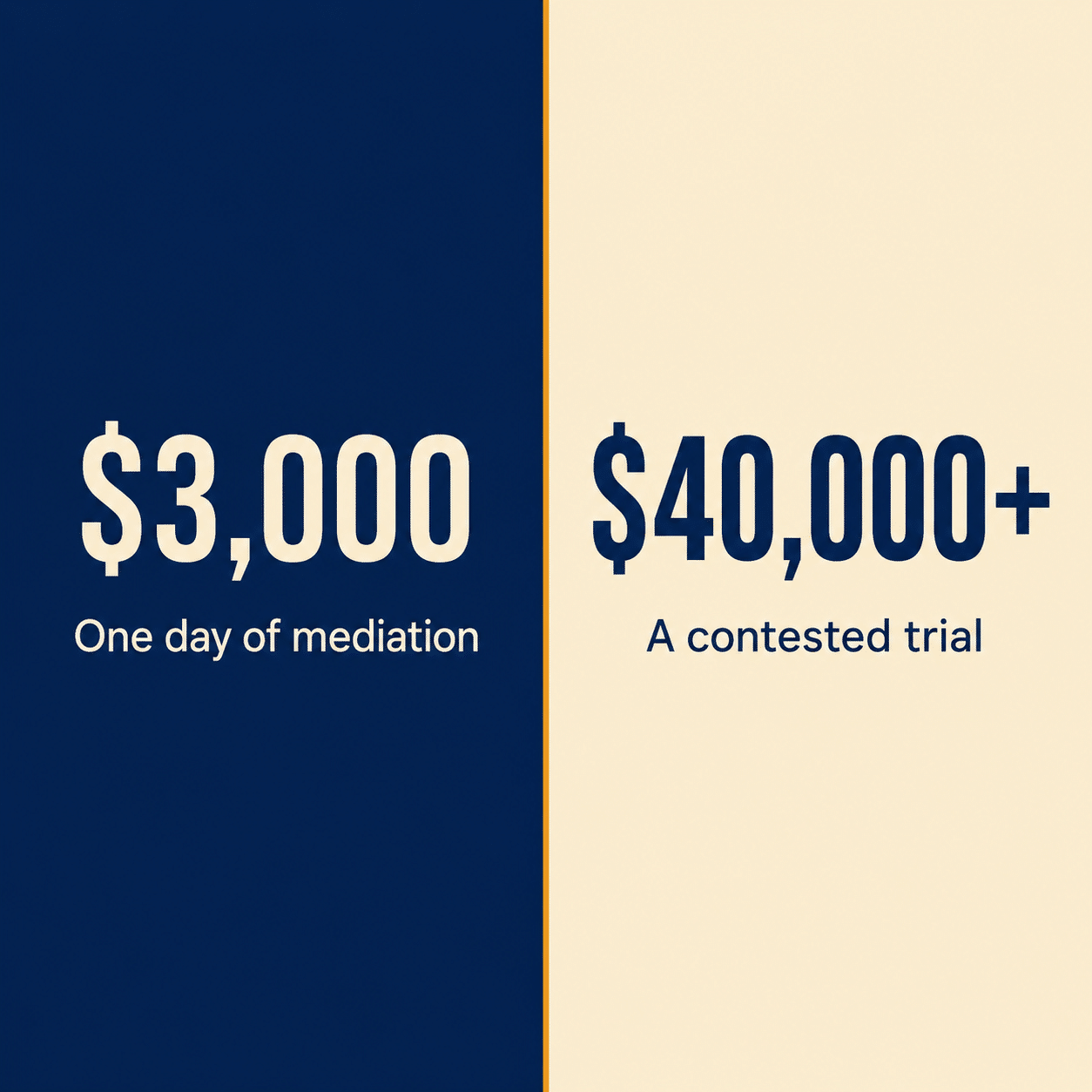
Even at private rates, the math favors mediation by a wide margin. A single day of mediation that costs a few thousand dollars can settle a case that would otherwise run $40,000 or more through trial preparation, depositions, and multiple days in court. Mediation also lets you build creative trade-offs a judge cannot, like keeping the family home in exchange for a larger share of a retirement account. This is why we lean on mediation and negotiated settlements as our main tool for keeping cases affordable.
How much does child support cost to determine?
Child support in North Carolina follows a formula called the income shares model. It combines both parents’ incomes, estimates what it costs to raise the child, and divides that cost between the parents based on what each earns, adjusting for overnights, childcare, and health insurance premiums.
When the parents’ combined adjusted gross income is $40,000 per month or less, the formula controls the result, which keeps that part of the case predictable and inexpensive. Above $40,000 per month, the guidelines no longer apply, and the court sets support based on the child’s actual needs and the family’s standard of living. That requires more evidence and more attorney time. You can estimate a guideline number yourself with our child support calculator.
The costs people forget to budget for
A realistic divorce budget goes beyond lawyers and court fees. Several other costs come up often, especially in Triangle households with real assets to divide.
Dividing a retirement account usually requires a Qualified Domestic Relations Order, or QDRO. Without one, pulling money out of a 401(k) or pension triggers taxes and an early withdrawal penalty. A QDRO is typically drafted for a flat fee of around $700, rising to $1,000 to $2,000 for complicated plans, and the plan administrator may charge another $350 to $1,800 to process it. Our guide to dividing retirement in divorce explains how this works.
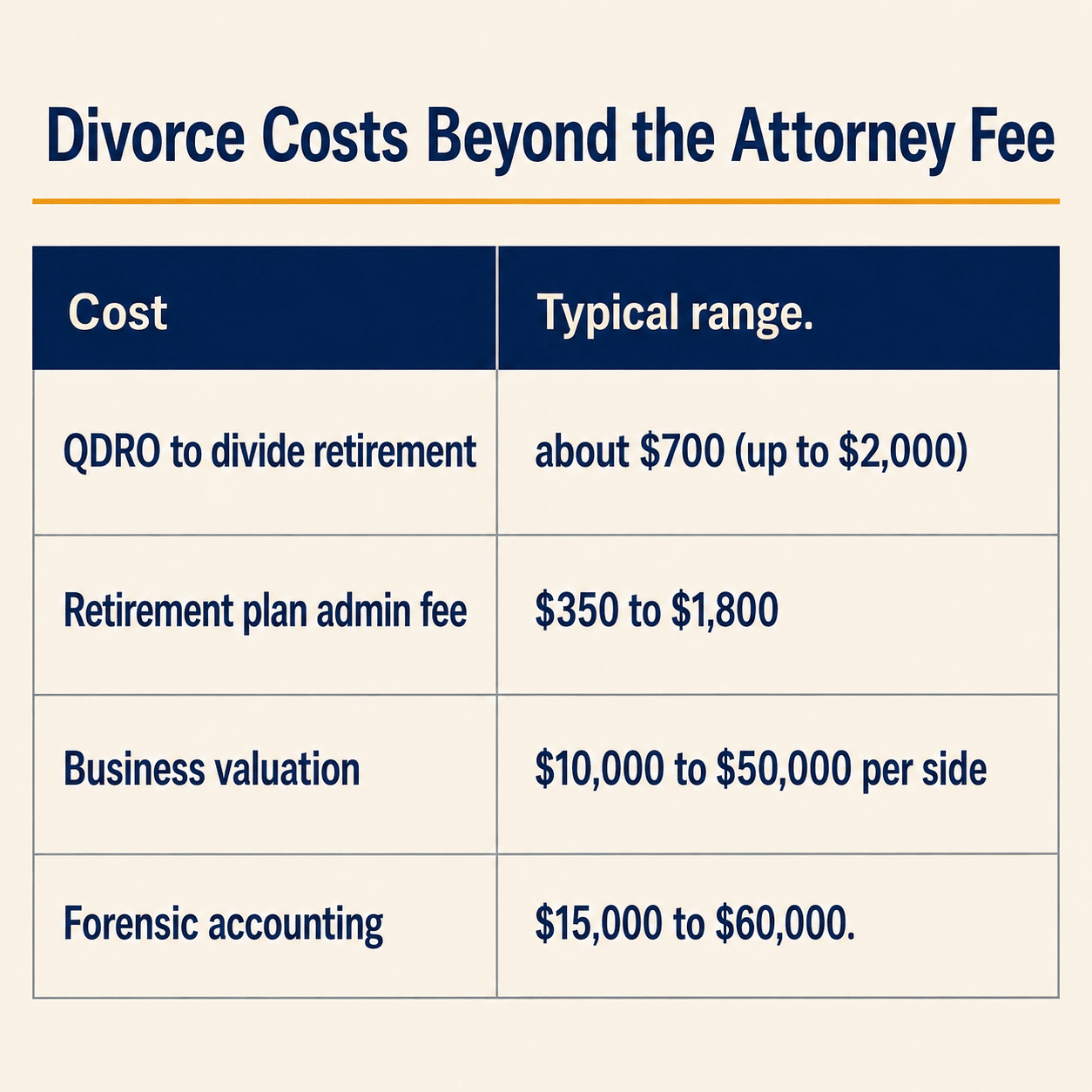
If a spouse owns a business, someone has to value it. A formal business valuation for a divorce typically runs $10,000 to $50,000 per side, and more for large or complex companies, because a valuation built to hold up in court costs more than a standard one. When there are concerns about hidden assets or underreported income, a forensic accountant bills roughly $300 to $600 per hour, and a high-asset engagement with hidden assets commonly runs $15,000 to $60,000.
Other costs vary by household and are harder to pin to a single number: a real estate appraisal if one spouse keeps the house, moving expenses and setting up a second household, and counseling for the adults or the children. These add up, so it helps to account for them early. Our overview of financial planning for divorce walks through the full picture.
Health insurance after divorce in North Carolina
Losing shared health coverage is one of the larger costs people do not see coming. The one-year separation requirement actually works in your favor here. Because the legal divorce decree is what removes a spouse from an employer health plan, a dependent spouse can usually stay on the other spouse’s employer coverage through the entire separation year, up until the absolute divorce is granted.
After the divorce, that coverage ends and the costs shift to you:
- COBRA lets you keep your existing plan for up to 36 months, but you pay 102% of the full premium, which commonly runs $400 to $700 per month. If your spouse’s employer has fewer than 20 employees, North Carolina’s state continuation coverage law, often called Mini-COBRA, offers similar continuation for up to 18 months.
- An Affordable Care Act marketplace plan is the other option. A divorce qualifies you for special enrollment, and the average individual premium sits around $560 per month before any income-based subsidies.
Either way, plan for roughly $500 or more per month per person once the separation year ends. The U.S. Department of Labor has detailed guidance on how COBRA works.
North Carolina County Courthouse Information
| County | Address | Hours |
|---|---|---|
| Wake County | 316 Fayetteville St Raleigh NC 27601 | Monday: 8:30am-5:00pm Tuesday: 8:30am-5:00pm Wednesday: 8:30am-5:00pm Thursday: 8:30am-5:00pm Friday: 8:30am-5:00pm Saturday: Closed Sunday: Closed |
| Durham County | 510 S Dillard St Durham, NC 27701 | Monday: 8:30am-5:00pm Tuesday: 8:30am-5:00pm Wednesday: 8:30am-5:00pm Thursday: 8:30am-5:00pm Friday: 8:30am-5:00pm Saturday: Closed Sunday: Closed |
| Chatham County | 40 E Chatham St Pittsboro, NC 27312 | Monday: 8:30am-5:00pm Tuesday: 8:30am-5:00pm Wednesday: 8:30am-5:00pm Thursday: 8:30am-5:00pm Friday: 8:30am-5:00pm Saturday: Closed Sunday: Closed |
| Johnston County | 207 E Johnston St #209 Smithfield, NC 27577 | Monday: 8:00am-5:00pm Tuesday: 8:00am-5:00pm Wednesday: 8:00am-5:00pm Thursday: 8:00am-5:00pm Friday: 8:00am-5:00pm Saturday: Closed Sunday: Closed |
| Orange County | 106 E Margaret Ln Hillsborough, NC 27278 | Monday: 8:30am-5:00pm Tuesday: 8:30am-5:00pm Wednesday: 8:30am-5:00pm Thursday: 8:30am-5:00pm Friday: 8:30am-5:00pm Saturday: Closed Sunday: Closed |
The emotional cost of divorce
Not every cost shows up on a bill. Divorce takes a real toll on your confidence, your sense of stability, and your mental health, and both spouses often feel it. That weight is one more reason to resolve things through agreement where you can. Most people find that settling the terms, rather than fighting them out in court, eases the financial strain and the emotional strain at the same time.
How to keep your divorce cost under control
You have more influence over the final number than most people realize. A few decisions make the biggest difference:
- Agree on what you can. Every issue you and your spouse settle directly takes attorney time and expense off the table. At least half the people who call us start out thinking they can handle it themselves, and for many matters a “kitchen table” conversation followed by a lawyer drafting or reviewing the agreement is the most affordable path.
- Choose settlement over litigation. A negotiated settlement through mediation costs far less than a trial, and that is where the largest savings are. Our pricing page explains how our fixed fee is structured.
- Pick a predictable fee structure. A fixed fee gives you cost certainty and removes the open-ended risk of hourly billing.
- Budget for the whole picture. Account for the QDRO, any valuations, and the health insurance costs that arrive after the divorce is final, not just the attorney fee.
Take the next step
Every divorce is different, and the best way to understand your own likely cost is to talk it through with someone who handles these cases every day. We specialize in North Carolina family law, we are led by a North Carolina Board-Certified Family Law Specialist with more than 30 years in the Triangle, and we will tell you plainly what your situation involves and what it will cost. When you are ready, take the next step and reach out for a fixed-fee consultation.
This article is general information about North Carolina law and is not legal advice. Outcomes depend on the specific facts of each case.

Lisa is a leading figure in North Carolina’s family law field, dedicated to guiding clients through challenging times with compassion and expertise. As the President and Owner of Rosen Law Firm, P.A., Lisa has built a successful practice specializing in divorce, child custody, child support, alimony, equitable distribution, and domestic violence. She has been a North Carolina Board-Certified Specialist in Family Law since 1998.