

If your spouse files for divorce first in North Carolina, you are not at a legal disadvantage. Filing first does not give your spouse a stronger claim to the house, the retirement accounts, support, or custody. What matters is how you respond. In most cases you have 30 days from the day you are served to file a written answer, and you need to make sure any claims for alimony and property division are formally on the table before the divorce becomes final. At Rosen Law Firm, we favor out-of-court resolution and work to reach agreement through mediation wherever possible, so most people who are served never end up in a courtroom. Being served is the start of a process you can plan for, and this guide walks you through what to do.
What it means when your spouse files for divorce first in North Carolina
When your spouse files, the court issues a summons along with a complaint, and you are “served” with both. Service usually happens through the county sheriff, or by certified mail with a return receipt, or through a designated delivery service. Being served means the court now has authority over your case and a response clock has started.
The complaint spells out exactly what your spouse is asking the court to decide. Read it closely, because it tells you whether you are dealing with a simple divorce or something broader. That one detail shapes everything you do next.
“Filing for divorce” in North Carolina means two different things
In North Carolina, “filing for divorce” can point to two separate legal actions that people often lump together.
The first is an action for absolute divorce, which does one thing: it legally ends the marriage. To get an absolute divorce, a spouse only has to show that the two of you have lived separate and apart for one year and that at least one of you has lived in North Carolina for the six months before filing, under N.C. Gen. Stat. § 50-6. Living separate and apart means living in different homes. Sleeping in separate bedrooms under the same roof does not count, and the year has to be continuous. Once those requirements are met, the absolute divorce itself is mostly a formality.
The second meaning is a broader family law lawsuit that asks the court to decide things like child custody, child support, post-separation support, alimony, and the division of marital property. These claims are often filed in the same complaint as the absolute divorce, but they are separate causes of action under different statutes. They can also be filed as soon as you separate, long before the one-year mark.

Here is the practical difference:
| Absolute divorce | Custody, support, and property claims | |
| What it decides | Legally ends the marriage | Custody, child support, alimony, and how property is divided |
| Timing | After 1 year of separation and 6 months of NC residency | Any time after you separate |
| If you do nothing | The divorce can still be granted | You can permanently lose the right to ask for alimony and property division |
Sorting out which one you were served with is the first thing to do, because what comes next is very different for each.
How long you have to respond after your spouse files
In most cases you have 30 days from the date you are served to file a written answer, along with any counterclaims, under N.C. Gen. Stat. § 1A-1, Rule 12(a)(1). The day you are served does not count toward the 30 days. If the last day falls on a weekend or a court holiday, your deadline rolls to the next business day.
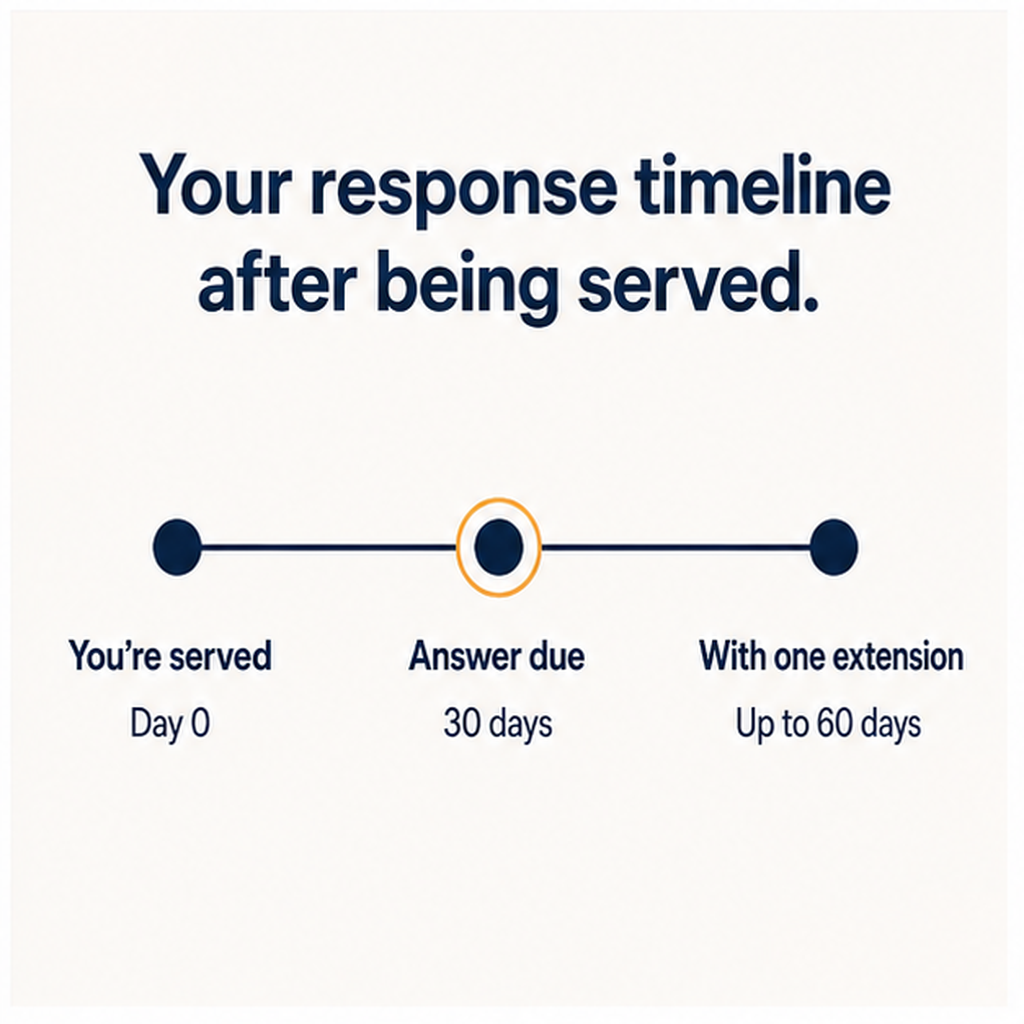 If you need more time to find an attorney and figure out your finances, you can usually get one 30-day extension from the Clerk of Superior Court, as long as you ask before your original 30 days run out. Requesting that extension does not count as agreeing to anything or giving up your defenses, so it is a safe, routine step. In practice, that gives you up to about 60 days to respond.
This deadline applies whether the complaint asks only for a simple divorce or also raises claims for property, support, or custody. Whatever you do, do not let the deadline pass without acting. If you want to understand the mechanics in more detail, our overview of basic court procedure in North Carolina breaks it down.
Why you must claim alimony and property division before the divorce is final
This is the point that matters most, and it is the one people miss.
Under North Carolina law, once a judgment of absolute divorce is entered, you permanently lose the right to ask for equitable distribution of marital property under N.C. Gen. Stat. § 50-11(e) and the right to ask for alimony under § 50-11(c), unless those claims were already filed and pending before the divorce was granted. The moment the judge signs the divorce decree, any unasserted claim to the home equity, retirement accounts, a pension, a share of a business, or spousal support can be gone for good.
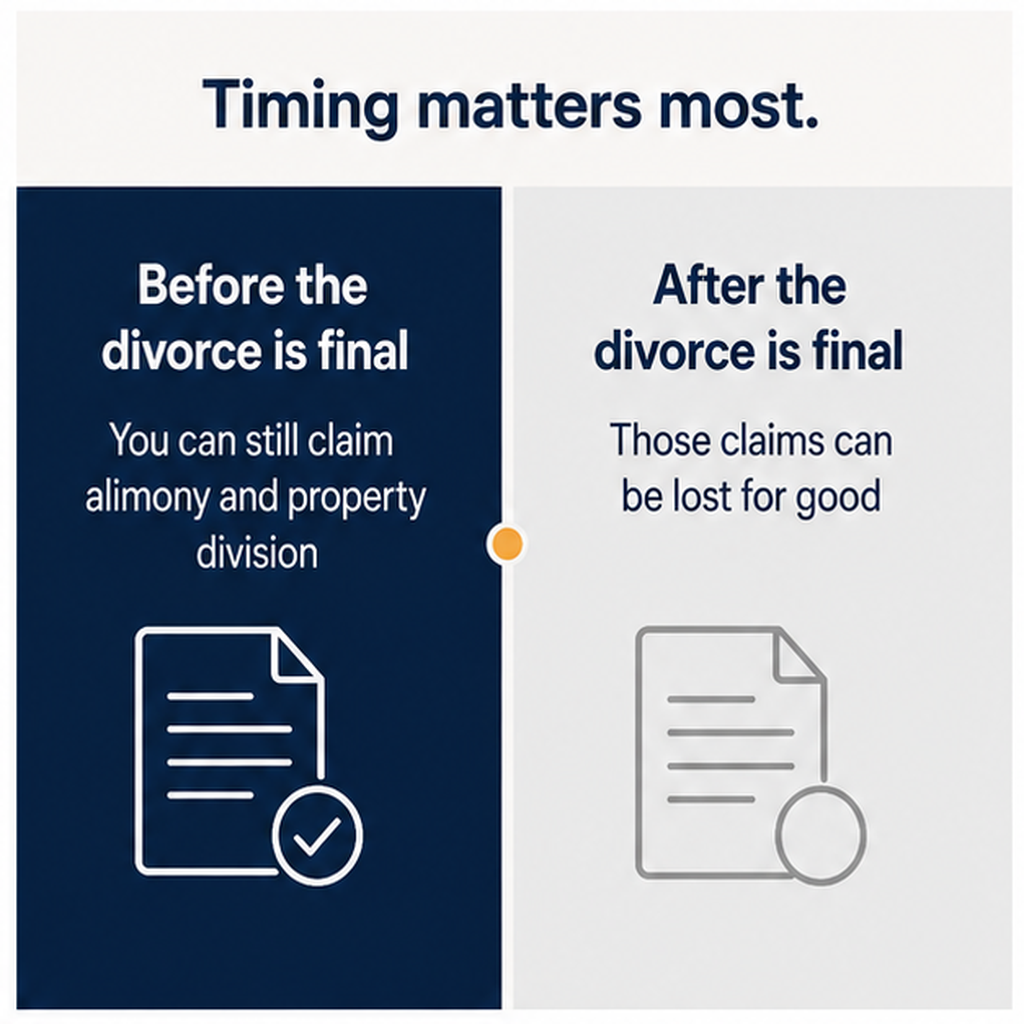 This trap catches people who assume a fair split will happen on its own. It will not. If your spouse files only for absolute divorce and you have financial claims, you have to raise them yourself, either as counterclaims in your answer or in your own separate action, before that divorce is final. Even a separation agreement that says a pension is “reserved” for later does not protect the claim unless it has actually been filed with the court before the divorce.

There are only two narrow exceptions, in § 50-11(e) and § 50-11(f). If the divorce was granted by a court that lacked authority over you or your property, or if you were served only by publication and never appeared in the case, you may have a six-month window after the judgment to file for equitable distribution. Outside those situations, the loss is permanent. Protecting your right to ask for support and a share of the marital estate comes down to filing on time.
Does it matter who files for divorce first in North Carolina?
 For the final outcome, no. Being the first to file, and holding the title of “plaintiff,” does not give a spouse an advantage in how property is divided or how custody is decided.
Property is divided under the equitable distribution factors in N.C. Gen. Stat. § 50-20(c), which look at things like the length of the marriage, each spouse’s income and debts, and each spouse’s contributions. The court does not care who filed first. Child custody is decided by the best interest of the child, which is also blind to who started the case.
There are a couple of small practical differences. The spouse who files pays the court filing fee, which is $225 for an absolute divorce (plus $10 if that spouse wants to resume a former name), according to the North Carolina Judicial Branch schedule of court costs. The filing spouse also picks the initial county where the case is filed, though state law includes safeguards against filing somewhere unfair. Being served second leaves your substantive rights fully intact.
Can you stop the divorce if your spouse filed first?
Usually not. North Carolina is a no-fault divorce state. If the one-year separation and six-month residency requirements are met, you cannot block the absolute divorce, even if your spouse caused the breakup or had an affair. Trying to fight the divorce itself on the grounds that your spouse behaved badly is not an argument the law recognizes, and it usually just burns time and money.
Marital misconduct does still matter in one important place: alimony. Under North Carolina’s alimony law (N.C. Gen. Stat. § 50-16.3A), misconduct like adultery, abandonment, or reckless spending can affect whether alimony is awarded and how much. So for most people, the smart move is to treat the end of the marriage as a formality and put their energy where the law actually gives it weight, in the financial and custody terms.
What to do after your spouse files for divorce: step by step
- Write down the date you were served. Your 30-day response clock starts the next day, so the exact date matters.
- Read the complaint carefully. Note whether it asks only for absolute divorce or also for custody, child support, alimony, or property division. That tells you what you need to respond to.
- Do not ignore the papers. Skipping a response is the one move that can cost you everything (more on that below).
- Gather your financial documents. Pull together records for bank and retirement accounts, real estate, income, debts, and any business interests. Your attorney will need them, and you may have to file a property inventory.
- Talk to a family law attorney before you respond. This is especially important if you have real assets like a home, retirement, or a business at stake. A short consultation can tell you what claims you need to protect.
- File your written answer and any counterclaims on time. File the original with the Clerk of Superior Court in the county where the case was filed, and send a copy to your spouse or their attorney. If you have claims for alimony or property division, include them here. Your answer often has to be verified in front of a notary, so build in time for that step.
What happens if you ignore the divorce papers
If you do nothing, your spouse can ask the court for a default. First, after your 30 days pass with no response, the Clerk of Superior Court can enter default, which means the facts in the complaint are treated as admitted. Then a judge can enter a default judgment, grant the divorce, and, under § 50-11, permanently wipe out any alimony and property claims you never filed.
The encouraging part is how easy this is to avoid. Filing any answer, even a late one submitted before your spouse asks for default, counts as showing up in the case and stops the clerk from entering default against you. It keeps you at the table. Doing nothing is the only response that costs you by default.
Will your divorce go to court?
Most North Carolina divorces settle without a trial. The court system actively pushes parties toward settlement. In disputes over property, alimony, and child support, judges can require a mediated settlement conference through the state’s Family Financial Settlement program before the case ever reaches a courtroom. However the entry of absolute divorce will be signed by the Court or entered by the Clerk of Court.
The results back this up. State figures show that more than 74% of family financial cases settled through mediation in the 2021 to 2022 fiscal year, up from about 68% the year before, according to the North Carolina Judicial Branch. We work to reach agreement through mediation wherever possible, keeping our clients’ matters out of court. For most families, being served leads to a negotiated settlement rather than a trial.
When filing first actually matters
Filing first does not change the math on property or custody, but there are a couple of urgent situations where moving quickly matters:
- A spouse is draining or hiding assets. If your spouse is emptying accounts, moving money, or transferring property, filing lets you ask the court for temporary orders to protect the marital estate before more disappears.
- Safety or a risk of a child being taken. In cases involving domestic violence or a real threat that a child will be removed from the state, filing lets a parent seek an emergency custody order, sometimes before the other parent is even notified.
If either of these applies to you, you do not have to be the one who filed first to get protection. You can ask the court for the same relief in your response or in your own filing. If your safety or your children’s safety is a concern, tell your attorney right away so they can act quickly.
Frequently asked questions
How many days do you have to respond to divorce papers in North Carolina? You generally have 30 days from the date you are served to file a written answer. You can usually get one 30-day extension from the Clerk of Superior Court if you request it before your original deadline passes.
Can you lose alimony or property if you do not respond in time? Yes. Once an absolute divorce is finalized, claims for alimony and equitable distribution that were not filed and pending beforehand are lost in almost all cases. That is why responding on time and asserting your claims is so important.
How much does it cost to file for divorce in North Carolina? The filing fee for an absolute divorce is $225, plus $10 if the filing spouse wants to resume a former name, based on the 2026 North Carolina schedule of court costs. The spouse who files pays this fee.
North Carolina County Courthouse Information
| County | Address | Hours |
|---|---|---|
| Wake County | 316 Fayetteville St Raleigh NC 27601 | Monday: 8:30am-5:00pm Tuesday: 8:30am-5:00pm Wednesday: 8:30am-5:00pm Thursday: 8:30am-5:00pm Friday: 8:30am-5:00pm Saturday: Closed Sunday: Closed |
| Durham County | 510 S Dillard St Durham, NC 27701 | Monday: 8:30am-5:00pm Tuesday: 8:30am-5:00pm Wednesday: 8:30am-5:00pm Thursday: 8:30am-5:00pm Friday: 8:30am-5:00pm Saturday: Closed Sunday: Closed |
| Chatham County | 40 E Chatham St Pittsboro, NC 27312 | Monday: 8:30am-5:00pm Tuesday: 8:30am-5:00pm Wednesday: 8:30am-5:00pm Thursday: 8:30am-5:00pm Friday: 8:30am-5:00pm Saturday: Closed Sunday: Closed |
| Johnston County | 207 E Johnston St #209 Smithfield, NC 27577 | Monday: 8:00am-5:00pm Tuesday: 8:00am-5:00pm Wednesday: 8:00am-5:00pm Thursday: 8:00am-5:00pm Friday: 8:00am-5:00pm Saturday: Closed Sunday: Closed |
| Orange County | 106 E Margaret Ln Hillsborough, NC 27278 | Monday: 8:30am-5:00pm Tuesday: 8:30am-5:00pm Wednesday: 8:30am-5:00pm Thursday: 8:30am-5:00pm Friday: 8:30am-5:00pm Saturday: Closed Sunday: Closed |
Does North Carolina divide everything 50/50? Not automatically. North Carolina uses equitable distribution. An equal split is the starting assumption, but a judge can divide property unequally based on the factors in the state’s property division law.
Take the next step
Being served can feel like the ground shifted under you, but you have time and you have options. We built Rosen Law Firm around giving people clear information and cost certainty, with a fixed fee set up front so you know what you will pay from the start. Our firm focuses on North Carolina family law, and our president, Lisa Angel, is a North Carolina Board-Certified Family Law Specialist with more than 30 years of experience in the Triangle.
If your spouse has filed, or you think they are about to, talk with us before your response deadline passes. Take the next step, and we will help you understand your options and protect what matters most to you. We handle divorce and family law matters throughout Wake, Durham, Orange, and Johnston counties, and we can help with non-litigation matters anywhere in North Carolina.
This article is general information about North Carolina law and is not legal advice. Outcomes depend on the specific facts of each case.

Lisa is a leading figure in North Carolina’s family law field, dedicated to guiding clients through challenging times with compassion and expertise. As the President and Owner of Rosen Law Firm, P.A., Lisa has built a successful practice specializing in divorce, child custody, child support, alimony, equitable distribution, and domestic violence. She has been a North Carolina Board-Certified Specialist in Family Law since 1998.