

When the largest thing a couple owns is a business, a block of stock options, or a stake in a private fund, dividing it is rarely as simple as writing a check. These assets hold real marital value, but you often cannot sell or transfer them today without wrecking the value, triggering a tax bill, or waiting on an event that has not happened yet. North Carolina handles all of them through the same three steps: classify the asset as marital, separate, or divisible; value it; then divide it using a method that does not force a fire sale. In most cases that means a buyout, an offset against other property, a cash distributive award, or a deferred “if, as, and when received” split, worked out in a written agreement rather than fought over in a courtroom.
At Rosen Law Firm, high-asset and business-owner divorce is one of the areas we work in most, and roughly 85% of our cases reach agreement through mediation instead of a trial. That matters here, because illiquid assets almost always get resolved best at the negotiating table, where the parties can build a payment structure that fits the asset instead of accepting whatever a judge orders. This guide walks through how North Carolina classifies, values, and divides the illiquid assets that show up most in high-net-worth divorces, the statutes and cases that control each step, and how a careful agreement keeps the split from turning into years of return trips to court.
What makes an asset illiquid, and why it complicates a divorce
An illiquid asset is worth real money but cannot be turned into cash quickly without losing value, triggering tax, or waiting for a future event. A brokerage account or a money market fund is liquid. A minority stake in a private equity fund is not. You cannot deposit half of a medical practice into your spouse’s bank account, and selling a professional practice in the middle of a divorce often destroys the very value you are trying to divide.
North Carolina’s equitable distribution statute anticipates this problem head on. Among the factors a court weighs in dividing an estate, N.C. Gen. Stat. § 50-20(c)(9) lists the liquid or nonliquid character of the property, and § 50-20(c)(10) lists the difficulty of evaluating any component asset or any interest in a business, corporation, or profession, along with the economic desirability of keeping that interest intact and free from interference by the other spouse. Those two factors are the statutory reason illiquid-asset cases so often end with one spouse keeping the asset and the other receiving equivalent value another way.
The illiquid assets that come up most in high-asset North Carolina divorces
Three families of assets create most illiquid-asset disputes. Each holds marital value, and each resists a clean split for its own reason.
Closely held businesses and professional practices
A business built or grown during the marriage is usually marital property, even when only one spouse runs it. The complication is that you often cannot divide the business in kind without ruining it, and if it is a licensed practice, the license itself belongs only to the licensed spouse. North Carolina expressly treats a professional or business license that would terminate on transfer as separate property under § 50-20(b)(2). The practice value built around that license, though, can still be marital. For the mechanics of splitting the entity itself, see our guide on dividing a business in a divorce.

Stock options, RSUs, and executive compensation
Equity compensation is the classic “earned now, paid later” asset. An option granted this year may not be exercisable for four more, and a restricted stock unit is only a promise of shares once a vesting date arrives. Because the award straddles work already performed and work still to come, its classification turns on when and why it was granted, not simply on when it vests. Stock options are common enough that we treat them separately; our page on dividing stock options in divorce goes deeper into the option-specific valuation formulas than we will here.
Private equity and private fund interests
Private equity stakes, limited partnership interests, and carried interest are the hardest of the three to value and to divide, and they have the thinnest North Carolina case law behind them. A fund interest may be locked up for years, and carried interest may pay nothing until the fund clears a return hurdle far in the future. We cover how North Carolina handles that gap later in this guide.
Step 1: Classify the asset as marital, separate, or divisible
Every North Carolina equitable distribution case starts with classification. Under § 50-20(a), the court first determines what is marital and divisible property, then divides it. The statute sorts property into three categories.
| Classification | What it includes |
| Marital property | Most real and personal property acquired by either spouse during the marriage and before separation, and still owned. The statute expressly includes vested and nonvested pension, retirement, and deferred compensation rights and benefits. |
| Separate property | Property owned before marriage, acquired in exchange for separate property, or received by gift or inheritance. It also includes any professional or business license that would terminate on transfer, and passive increases in the value of separate property. |
| Divisible property | The in-between category. It includes passive changes in the value of marital property after separation and, importantly, property received after separation that was earned through effort during the marriage, expressly including commissions, bonuses, and contractual rights. |
Illiquid assets rarely sit cleanly in one box. An option package, a business, or a fund interest is often part marital and part separate, depending on when the value was created.
That third category does a lot of the work in illiquid-asset cases. When a bonus, commission, or contractual right is paid after separation but was earned by marital effort before separation, § 50-20(b)(1a) treats it as divisible property that the estate can reach. So the fact that an award lands in the owner’s account after the marriage ends does not, by itself, put it out of bounds. What matters is when the work that earned it was done.
When a premarital business becomes partly marital
If one spouse owned a business before the marriage, the starting value stays separate. What happens after the wedding depends on why the business grew. North Carolina draws a line between passive appreciation, which stays separate, and active appreciation driven by marital money, labor, or a spouse’s effort during the marriage, which creates a marital interest. The North Carolina Court of Appeals set out this active-versus-passive rule in Wade v. Wade, which also recognized that a single asset can carry a dual classification, part separate and part marital.
A simple example shows why this matters. Suppose one spouse owned a company worth $100,000 at the wedding, and through the couple’s joint efforts during the marriage it grew to $500,000 by the date of separation. The $100,000 starting value stays separate, but the $400,000 of active increase is marital and subject to division. That is how a company that was small at the wedding and large at separation can carry a large marital interest even though it began as separate property. We address a common version of this worry on our property division for entrepreneurs page.
Time-based apportionment for awards earned across the marriage
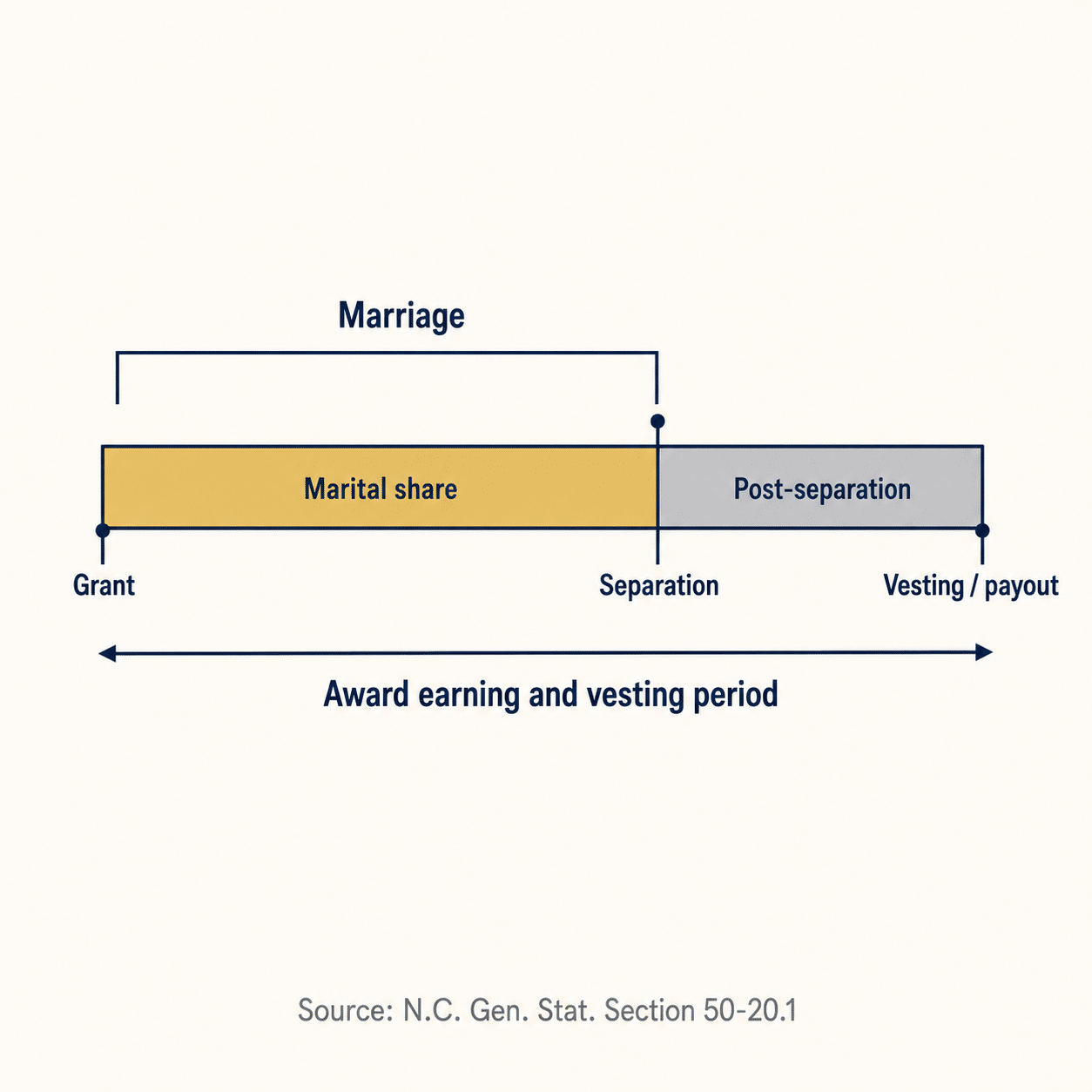
The coverture fraction under N.C. Gen. Stat. § 50-20.1: only the marriage portion of the earning period is marital.

For compensation that accrues over a service period, such as options, RSUs, and pensions, North Carolina uses a time-rule, or coverture-fraction, approach. Under § 50-20.1(d), the marital share is the proportion of the earning period that overlapped with the marriage, up to the date of separation, over the total earning period. The statute applies to all vested and nonvested pension, retirement, and deferred compensation plans, and § 50-20.1(h) sweeps in executive benefit plans and accounts under Internal Revenue Code sections 401(k), 403(b), and 457, along with IRAs.
Put concretely: if an option package vests over four years and the couple was married for two of those four years before separating, the coverture fraction makes roughly half of the award marital, even though the options cannot be exercised until later. The North Carolina Court of Appeals confirmed this framing for equity compensation in Fountain v. Fountain, holding that stock options are a form of deferred compensation and are marital when they are (1) received during the marriage, (2) before the date of separation, and (3) acquired as a result of a spouse’s efforts during the marriage, even if they cannot be exercised until after the divorce. Options granted for post-separation work are not marital.
 Step 2: Value the asset
 Step 2: Value the asset
Once you know what is marital, someone has to put a number on it. This is where illiquid-asset cases get expensive and expert-heavy, and where the value can be genuinely unknowable until a future event.
In our practice, we work with CPAs, certified valuation analysts, and forensic accountants, and we approach business value through the income, market, and asset approaches, depending on the company. North Carolina does not require a single method. The foundational case, Poore v. Poore, holds that a court values a practice as of the date of separation, that goodwill can be part of that value, and that no one valuation method is mandated, so long as the court reasonably approximates net value using a sound method supported by competent evidence and makes specific findings. Experts often separate enterprise goodwill, which attaches to the business, from personal goodwill, which attaches to the individual, because that line affects how much value the marital estate can reach. For a plain-language walkthrough, see our page on understanding a business valuation in your divorce.
Equity compensation follows the same principle. In Fountain, the Court of Appeals accepted the intrinsic value method for stock options, which subtracts the strike price from the stock price and multiplies by the number of options, and it declined to require the more complex Black-Scholes model. The practical takeaway is that North Carolina accepts more than one recognized approach, so the fight is usually over which method fits the facts, not over a single mandated formula.
The harder truth is that some of these assets cannot be pinned to a fixed number today. A business valuation is a snapshot. An RSU’s real value depends on the share price at vesting. A fund interest depends on how the fund performs. That uncertainty is exactly why the division step deserves more attention than the valuation number. A precise valuation does not help much if the division mechanics cannot handle an asset that pays out years from now.
Step 3: Divide the asset
This is the heart of the problem, and the part most articles skip. North Carolina starts from a presumption of an equal division by net value under § 50-20(c), and a separate presumption under § 50-20(e) that an in-kind distribution is equitable. That second presumption can be rebutted “by evidence that the property is a closely held business entity or is otherwise not susceptible of division in-kind.” Once it is rebutted, the statute directs the court to use a distributive award instead, which may be secured by a lien on specific property. When the asset cannot be cleanly cut, North Carolina relies on four mechanics.
| Method | How it works | When it fits |
| In-kind division | Split the actual asset between the spouses. | Assets that divide cleanly, such as cash or publicly traded shares. Rarely a business or fund interest. |
| Offset or buyout | One spouse keeps the asset; the other takes equivalent value in other property. | When there is enough other property to balance the estate. |
| Distributive award | One spouse pays the other cash, in a lump sum or over time. | When there is not enough other property to offset. |
| Deferred division (“if, as, and when received”) | Set a formula now and split the proceeds later, if and when the asset pays out. | Assets whose value depends on a future event, such as nonvested options or carried interest. |
In-kind division, and why it rarely fits an illiquid asset
Splitting the actual asset works for things that divide cleanly, like cash or publicly traded shares. It usually falls apart for a business, a professional practice, or a fund interest, because forcing two divorcing spouses into shared ownership of an illiquid, hard-to-govern asset tends to create the next lawsuit rather than end this one. The statute recognizes this by letting the in-kind presumption be rebutted for exactly these assets.
Offset or buyout
The cleanest solution, when the numbers allow, is for one spouse to keep the asset and the other to walk away with equivalent value in different property. If a business is worth $500,000 and is entirely marital, the owner keeps it and the other spouse receives $250,000 in value, often the house, a larger share of the retirement accounts, or a mix. This keeps the illiquid asset intact and in the hands of the person best positioned to run it, which is precisely the outcome § 50-20(c)(10) encourages when it points to the economic desirability of retaining a business interest free from interference by the other party.
Distributive award: cash, sometimes over time
When there is not enough other property to offset, § 50-20(b)(1) allows a distributive award, a cash payment from one spouse to the other. It can be paid in a lump sum or spread over time in fixed amounts, and under § 50-20(e) it can be secured by a lien on specific property. The statute does not set a fixed maximum term, so the payment timeline is a negotiated term rather than a hard number. Structuring a buyout over several years can make a business divorce workable, but the payment plan has to account for how the paying spouse will actually fund it, and for the tax consequences on both sides.
Deferred division: the “if, as, and when received” approach
For assets whose value depends on a future event, North Carolina recognizes deferred distribution: the parties fix a formula now and split the proceeds later, if and when the asset actually pays out. This is the standard answer for nonvested stock options and similar future-contingent compensation. It is grounded in § 50-20.1, which authorizes an award payable as the benefit is received and applies to both vested and nonvested plans. As a default, § 50-20.1(e) caps such an award at fifty percent of the benefit, with several exceptions, including when the other marital assets are insufficient or when a business interest is hard to distribute. The same logic runs parallel to how retirement accounts are split with a qualified domestic relations order.
Deferred division is powerful, but it is only as good as its drafting. Because the payout arrives years later, the agreement has to answer questions in advance rather than leave them open. Drawing on the protections we build into these agreements, the receiving spouse should be entitled to written notice, and the paying spouse should hold the asset in a way that protects the other side. At a minimum, a well-drafted deferred split should require:
- Notice to the non-owner spouse if the owner’s employment terminates.
- Notice when the owner exercises options or the asset otherwise pays out.
- Notice if the employer reprices options or grants replacement or substitute awards.
- Notice if the employer accelerates the vesting or maturity schedule.
- A constructive trust or similar mechanism so the owner holds the non-owner’s share and follows a defined process when new awards vest.
Leaving any of those blanks is how a clean divorce becomes a return trip to court three years later, arguing about a vesting date or an exercise nobody was told about.
How illiquid assets are taxed when you divide them
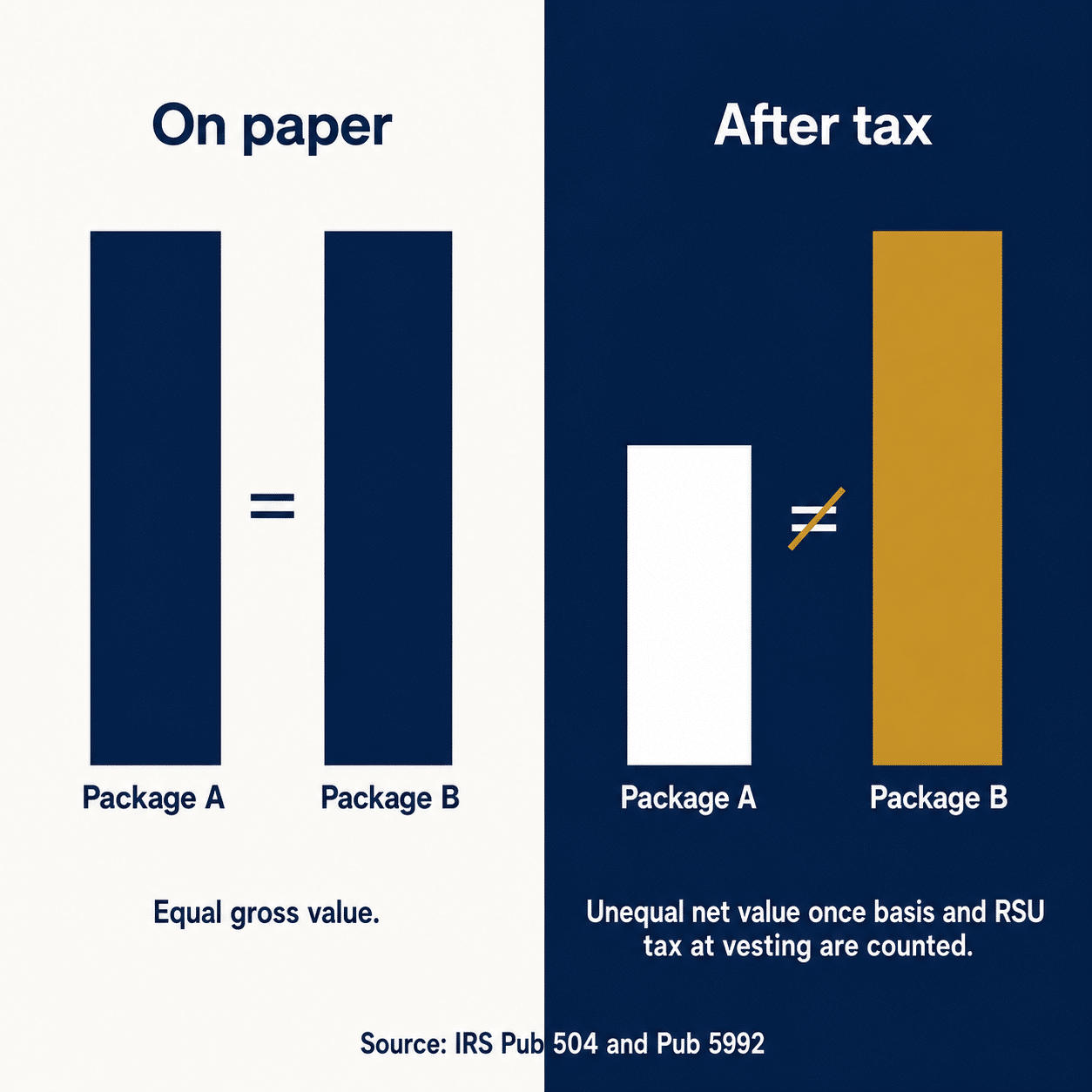
Two packages can be worth the same on paper and very different after tax. Federal law generally lets spouses transfer property between themselves incident to divorce without triggering tax at the time of transfer. IRS Publication 504 explains that no gain or loss is usually recognized on these transfers, and that the receiving spouse takes over the other spouse’s cost basis. The tax is deferred, not erased. Whoever ends up holding a low-basis asset inherits the built-in gain and pays it on a later sale.
Equity compensation adds its own wrinkles. RSUs are generally taxed as ordinary income when they vest, not when the divorce is final, so the person who receives the shares can face a wage-level tax bill down the road. Stock options split into two tax families, and the difference is easy to miss. Statutory, or incentive, options carry favorable capital-gains treatment, but transferring an incentive option to a former spouse generally strips that favorable status and converts it to a non-statutory option. Non-statutory options are taxed as ordinary income at exercise, with withholding and FICA. A split that ignores these rules can hand one spouse the same headline value and a much larger tax burden. Getting the after-tax picture right is part of valuing and dividing the asset, not an afterthought.
North Carolina County Courthouse Information
| County | Address | Hours |
|---|---|---|
| Wake County | 316 Fayetteville St Raleigh NC 27601 | Monday: 8:30am-5:00pm Tuesday: 8:30am-5:00pm Wednesday: 8:30am-5:00pm Thursday: 8:30am-5:00pm Friday: 8:30am-5:00pm Saturday: Closed Sunday: Closed |
| Durham County | 510 S Dillard St Durham, NC 27701 | Monday: 8:30am-5:00pm Tuesday: 8:30am-5:00pm Wednesday: 8:30am-5:00pm Thursday: 8:30am-5:00pm Friday: 8:30am-5:00pm Saturday: Closed Sunday: Closed |
| Chatham County | 40 E Chatham St Pittsboro, NC 27312 | Monday: 8:30am-5:00pm Tuesday: 8:30am-5:00pm Wednesday: 8:30am-5:00pm Thursday: 8:30am-5:00pm Friday: 8:30am-5:00pm Saturday: Closed Sunday: Closed |
| Johnston County | 207 E Johnston St #209 Smithfield, NC 27577 | Monday: 8:00am-5:00pm Tuesday: 8:00am-5:00pm Wednesday: 8:00am-5:00pm Thursday: 8:00am-5:00pm Friday: 8:00am-5:00pm Saturday: Closed Sunday: Closed |
| Orange County | 106 E Margaret Ln Hillsborough, NC 27278 | Monday: 8:30am-5:00pm Tuesday: 8:30am-5:00pm Wednesday: 8:30am-5:00pm Thursday: 8:30am-5:00pm Friday: 8:30am-5:00pm Saturday: Closed Sunday: Closed |
Equal gross value can mean very different net value once basis and RSU tax at vesting are counted.
Private equity and carried interest: where North Carolina law is still thin
 Private equity and carried interest: where North Carolina law is still thin
North Carolina has solid authority on businesses, professional practices, stock options, and deferred compensation. It has far less on private equity fund interests and carried interest. Currently there is no specific case law on carried interests and equitable distribution.
The defensible way to handle these interests is to separate two things that often get blurred together:
- The ownership interest itself. This fits the closely held business framework: hard to value, illiquid, and often best kept intact with one spouse while the other is made whole another way.
- Compensation-like rights, including carry. Performance rights earned across a service period fit the deferred-compensation and contractual-rights framework of § 50-20(b)(1a) and § 50-20.1, which points toward time-based apportionment and deferred, pay-as-received division.
In practice, that means these interests get resolved through expert valuation, a negotiated allocation, and carefully drafted future-payment terms, rather than a simple “sell it and split it.” Because the law is unsettled here, the quality of the agreement matters even more than usual.
Settling illiquid assets in a separation agreement
Almost all of this gets resolved by agreement, not by a judge. Section 50-20(d) expressly lets spouses divide marital and divisible property by written agreement, duly executed and acknowledged under § 52-10 and § 52-10.1, in a manner they consider equitable. In our experience that is where illiquid assets are handled best, because the parties can engineer a solution the statute’s default remedies cannot. A negotiated agreement lets you match the payment structure to the asset: a buyout schedule that tracks a business’s cash flow, a deferred formula for an option package, an offset that keeps a practice in one spouse’s hands.
A carefully drafted agreement involving illiquid assets should nail down, at a minimum:
- The classification theory for each asset, and how post-separation appreciation is treated.
- The valuation date and the valuation method the parties are relying on.
- The payment timeline for any buyout or distributive award, and security for deferred payments.
- The mechanics for exercising or receiving future compensation, including the notice provisions above.
- How taxes are allocated between the spouses.
Every blank left in that list is a future dispute. The point of a good agreement is to answer these questions once, while both sides are cooperating, so nobody is back in a courtroom later arguing about a vesting date.
These are complex, expert-heavy matters, and they are exactly the kind of case where open-ended hourly legal bills tend to spiral. Rosen Law Firm is led by Lisa Angel, a North Carolina State Bar Board Certified Specialist in Family Law, and we work on a fixed fee set at the outset, so you have cost certainty on the legal side while you sort out assets that are anything but certain.
Frequently asked questions
Is my professional license split in a North Carolina divorce?
No. Under § 50-20(b)(2), a professional or business license that would terminate on transfer is separate property, so the license itself is not divided. The value of the practice built around that license, however, can be marital property and subject to division.
Can my spouse force me to sell my business in a divorce?
Usually not. The in-kind presumption in § 50-20(e) can be rebutted for a closely held business, which lets a court or an agreement leave the business with one spouse and balance the estate through an offset or a cash distributive award instead of a forced sale.
How are RSUs divided in a North Carolina divorce?
RSUs are analyzed like other service-earned compensation. The marital share depends on how much of the vesting period overlapped with the marriage under the coverture fraction, and they are commonly divided through a deferred, pay-as-received formula because the shares and the tax hit both arrive at vesting.
What if an option or bonus is paid after we separate?
It may still be reachable. Section 50-20(b)(1a) classifies commissions, bonuses, and contractual rights received after separation as divisible property when they were earned through effort during the marriage. The timing of the payout does not control; the timing of the work that earned it does.
Take the next step
If your divorce involves a business, equity compensation, or a fund interest, the way those assets are classified, valued, and divided will shape your finances for years, and the right approach depends on the specific facts of your case. We handle high-asset and business-owner divorces across Wake, Durham, Orange, and Johnston counties, and we build agreements designed to hold up long after the divorce is final. Take the next step and reach out to talk through your situation and get a clear plan.
This article is general information about North Carolina law and is not legal advice. Outcomes depend on the specific facts of each case.

Lisa is a leading figure in North Carolina’s family law field, dedicated to guiding clients through challenging times with compassion and expertise. As the President and Owner of Rosen Law Firm, P.A., Lisa has built a successful practice specializing in divorce, child custody, child support, alimony, equitable distribution, and domestic violence. She has been a North Carolina Board-Certified Specialist in Family Law since 1998.