

Most of what a separation agreement costs in North Carolina is the lawyer’s fee. What yours costs depends mostly on how much you already agree on and how much the agreement has to cover. To estimate the legal fees for your situation, try our free attorney fee calculator.
The only other cost every agreement has is notarizing your signatures. If you both sign in person, a notary can charge no more than $10 per signature, or $20 for the two of you. There is no court fee, because you don’t file a separation agreement with a court.
At Rosen Law Firm, we charge a fixed fee for separation agreements instead of billing by the hour. I’ve been a North Carolina Board-Certified Family Law Specialist since 1998. Our firm has practiced family law in North Carolina for more than 30 years.
How much does a lawyer charge for a separation agreement in North Carolina?
Lawyers charge for a separation agreement in one of two ways: a fixed fee for the whole agreement, or by the hour.
- Fixed fee. One price for the whole agreement, quoted before any work starts. What it covers varies from firm to firm, so ask what’s included.
- Hourly rate. Family lawyers in North Carolina averaged $322 an hour in 2025, according to Clio’s Legal Trends data. That figure is the most recent available, and rates can change from year to year, so ask any lawyer you’re considering for their current rate. You can’t compare that rate with a fixed fee until you know how many hours your agreement will take.
 Can you and your spouse use the same lawyer for a separation agreement?
 Can you and your spouse use the same lawyer for a separation agreement?
You and your spouse can’t have one lawyer prepare your separation agreement for both of you, even if you agree on everything. The North Carolina State Bar answered this question in 2019 Formal Ethics Opinion 1. The couple in the opinion had agreed on their terms, couldn’t afford two lawyers, and asked one lawyer to prepare the agreement for both of them. The Bar’s answer was no, even with both spouses’ consent.
The Bar’s reason is that spouses are on opposite sides of a separation agreement, even when they agree on the terms. Whatever one of you gives up in the agreement, such as a share of the house or a retirement account, the other one gets. A lawyer preparing the agreement for both of you would have to negotiate those terms for both sides at once. The Bar concluded that in that position, “impartiality is rarely possible.”
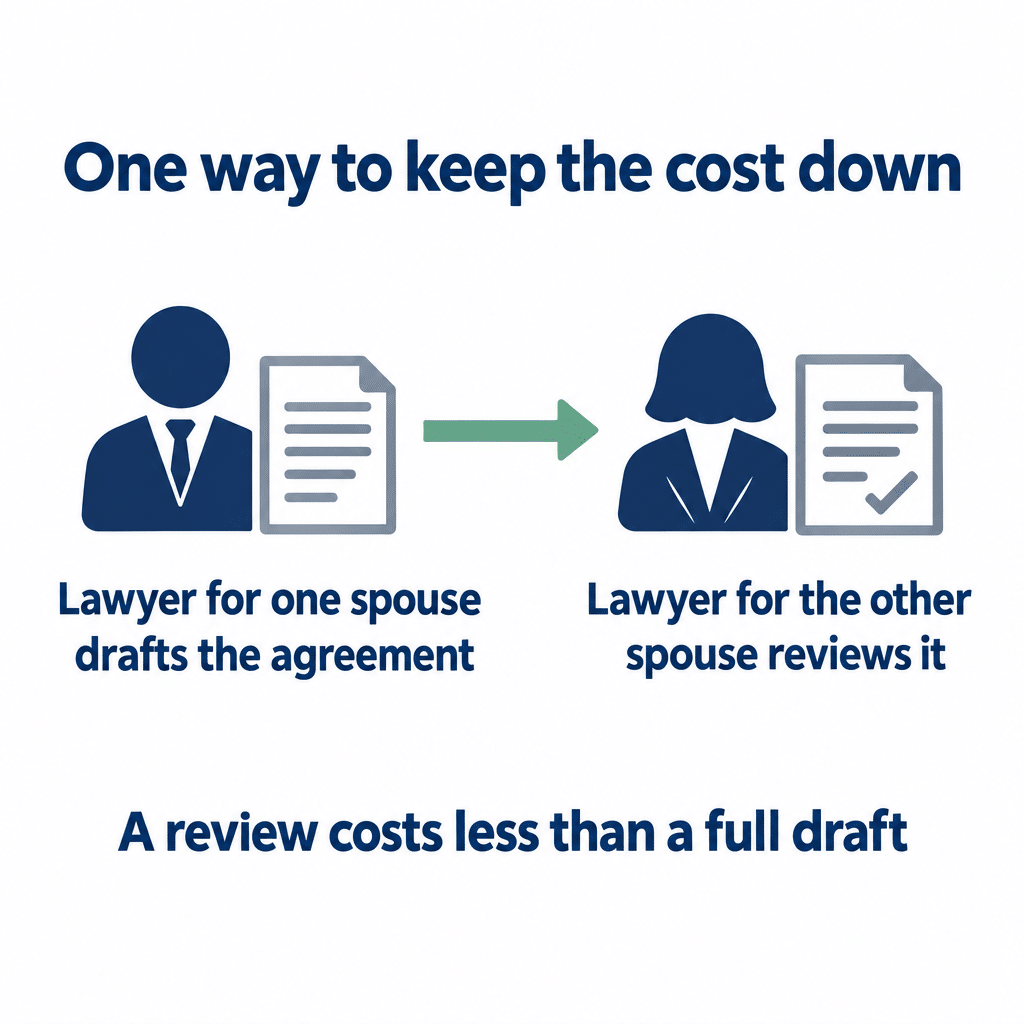
For your budget, that means paying two lawyers if you both want one. Our suggestion for keeping that cost down is to have one spouse’s lawyer draft the agreement while the other spouse pays a second lawyer only to review it, since a review costs less than a full draft.
Other costs that come with a separation agreement
These costs can come on top of the lawyer’s fee:
| Cost | When it comes up | What it costs |
|---|---|---|
| Notarizing both signatures | Every agreement, because North Carolina law requires both spouses’ signatures to be notarized (N.C. Gen. Stat. § 52-10.1) | Up to $10 per signature when you sign in person (N.C. Gen. Stat. § 10B-31(1)). Other ways of notarizing cost more. For example, remote notarization, done over a video call, can cost up to $25 per signature (§ 10B-31(4)). A notary who travels to you can also charge mileage, but only if you agree to it in writing beforehand (§ 10B-31(5)). |
| Recording a deed | The agreement puts the house in one spouse’s name | The Register of Deeds charges $26 for the first 15 pages and $4 for each page after that (N.C. Gen. Stat. § 161-10(a)(1)). Having the deed drawn up is a separate charge unless your lawyer’s fee includes it. |
| Preparing a QDRO | The agreement divides a 401(k) or pension. Your separation agreement isn’t filed with a court, but to split the account, the plan needs an order from a state court, called a qualified domestic relations order (QDRO). | Having one prepared can cost over $1,000, according to a 2023 Kiplinger article (a national figure). Dividing more than one plan can add to the cost. |
The divorce itself is a separate cost. When you file for divorce after a year of separation, the court’s filing fee is currently $225. Our article on how much a divorce costs in North Carolina covers the rest of that bill.
What makes a separation agreement cost more or less?
The more your agreement has to settle, and the more you and your spouse still disagree about, the more lawyer time it takes and the higher the price. These are the main things that move the cost:
- Children. A custody schedule and child support terms add sections to negotiate and draft.
- The house. Deciding who keeps it or whether to sell it, and who pays the mortgage in the meantime, adds terms to negotiate.
- Retirement accounts. Agreeing on how to split each 401(k), pension or other account adds terms to negotiate.
- Alimony. Whether one spouse will pay support, how much and for how long all need careful negotiation and drafting.
- A business. If either of you owns a business, you may need an outside valuation before you can agree on what it is worth.
- How much you already agree on. Writing down terms you have already settled takes much less lawyer time than negotiating every term from scratch.
- Rounds of negotiation. Each time a draft goes back for changes, the lawyer spends more time on it.
- Whether your spouse has a lawyer. If your spouse hires a lawyer, your lawyer negotiates with theirs, and every exchange of drafts takes time on both sides.

The most direct way to lower the price is to settle as much as you can with your spouse before a lawyer starts drafting. Where it’s realistic, we encourage spouses to try working out the terms between themselves first, at the kitchen table.
Ways to get a separation agreement and what each one costs
You can get a separation agreement in four main ways, from writing it yourselves for the cost of a notary to having a lawyer draft and negotiate the whole thing.
| Route | What you pay | Who it fits |
|---|---|---|
| Write it yourselves from a sample | Notary fees only (up to $20 if you both sign in person) | Couples with no children, little property and full agreement on every term |
| Write it yourselves and pay a lawyer to review it | Notary fees, plus a review fee for each spouse who wants one | Couples who have agreed on the terms and want a lawyer to confirm the agreement protects them and says what they mean |
| Mediation plus a lawyer review | Notary fees, review fees and the mediator’s hourly fee. Nolo reports that mediators who are lawyers typically charge $250 to $500 an hour, and mediators who aren’t lawyers typically charge about $100 to $350 an hour. | Couples who agree on most things but are stuck on a few |
| A lawyer drafts and negotiates it | Notary fees and the lawyer’s fee to draft, plus any deed or QDRO costs | Agreements involving children, the house, retirement accounts, alimony or a business, or a spouse who has hired a lawyer |
At Rosen Law Firm, we review agreements spouses have written themselves, draft and negotiate agreements from the start, and take over when spouses’ own negotiations stall. If you choose mediation, you and your spouse negotiate with the help of a mediator, a neutral third person who doesn’t take either side. We can represent you in mediation, but we don’t serve as the mediator.
Whether you need a lawyer at all depends on your situation. Our article on whether you need a lawyer to write a separation agreement in North Carolina can help you decide. If you write your own, our guide to drafting a separation agreement walks through how to do it.
Is a cheap or DIY separation agreement worth the risk?
A cheap agreement can end up costing more than a lawyer would have, because some mistakes give up rights you can’t get back after the divorce. Our own free sample agreement carries this warning: “Use of this form as your separation agreement without attorney guidance would be a mistake.” A missing or badly written term can cost you in several ways:
- Giving up property you didn’t mean to. A homemade agreement can include a broad sentence in which each spouse gives up any claim to the other’s property. North Carolina law lets spouses give up those rights in a written agreement that both of them sign in front of a notary (N.C. Gen. Stat. § 52-10(a); § 52-10.1). Depending on its wording, a promise to give up any claim can cover property the agreement never lists. If it does, you can lose the right to ask a court for your share of that property.
- Leaving property out. A court can still divide property the agreement leaves out, as long as the agreement doesn’t give up your rights to that property. One of you has to file a claim asking the court to divide it, and the claim has to be filed before the divorce is final. Once the divorce is final, the right to have a court divide it ends (N.C. Gen. Stat. § 50-11(e)).
- Leaving alimony out. An agreement that doesn’t mention alimony can hurt either spouse, depending on what each of you expects.
- If you’re the spouse who could be asked to pay alimony, an agreement that doesn’t mention it leaves your spouse free to file an alimony claim before the divorce is final. For your spouse to give up alimony, the agreement has to say so explicitly (N.C. Gen. Stat. § 50-16.6(b)).
- If you expect to receive alimony, leaving it out of the agreement doesn’t end your right to it. What ends the right is the divorce becoming final before you’ve filed an alimony claim with the court (§ 50-11(c)).
- Writing a term too vague to enforce. If your spouse stops following the agreement, you may have to ask a court to enforce it. A vague term gives your spouse room to argue that it means something else.
A review by your own lawyer costs less than a full draft and gives you a chance to catch problems like these before you sign. If your spouse hands you an agreement to sign, have your own lawyer read it first.
Is there free or low-cost help with a separation agreement?
Free and low-cost help with a separation agreement is available, whether you want to learn how agreements work or get a lawyer’s advice for less:
- Our free sample separation agreement. You can download it with attorney notes or as a Word document.
- Our free separation agreement eCourse. It has 13 lessons on separation agreements.
- Our free attorney fee calculator. You can use the calculator to estimate legal fees.
- DIY Divorce. Our online self-help program includes separation agreement forms and attorney support by email for $199 a month or $995 a year.
- The NC Bar Association’s Lawyer Referral Service. Calling the service is free, and it will refer you to a lawyer at no charge. If you tell that lawyer the service referred you, your first 30-minute consultation costs no more than $50. The service’s number is (919) 677-8574, and its Find a Lawyer FAQs explain how it works.
- Legal Aid of North Carolina. Legal Aid gives free legal help to low-income North Carolinians, including help with divorce and child custody. Call its helpline at 1-866-219-5262 (9 a.m. to 3 p.m., Monday through Friday) to ask whether it can help with your agreement.
Hourly or fixed fee: which is easier to budget for?
A fixed fee is easier to budget for, because you know the price before any work starts. With hourly billing, you won’t know your total until the work is done.
If an open-ended legal bill is what worries you most, look for a firm that quotes a fixed fee. You can read more about how our fixed fee works. Whichever firm you choose, a fixed fee only helps your budget if you know what it covers.
What to ask a lawyer about price at your consultation
A few direct questions at a consultation will tell you what you’ll actually pay and what could change it:
- Do you charge a fixed fee or bill by the hour? If hourly, what is your rate, and what do you expect the whole agreement to cost?
- What does the fee cover: drafting, revisions, negotiation with my spouse or their lawyer, and the signing?
- Are deeds, a QDRO or mediation included, or billed separately?
- What happens to the price if negotiations take longer than expected?
- Will you review an agreement my spouse and I wrote ourselves, and what does a review cost?
- When do I pay, and do you require a retainer (an upfront deposit)?
We’re glad to answer every one of these questions for your situation. We work with clients on separation agreements anywhere in North Carolina. Most consultations happen by Zoom, and we also meet in person in Raleigh and across the Triangle. The consultation is a paid meeting with a set price. You’ll leave it with real guidance and, where it fits your situation, a fixed-fee quote for your separation agreement. For pricing, or to schedule your consultation, Take the Next Step.
This article is general information about North Carolina law and is not legal advice. Outcomes depend on the specific facts of each case.

Lisa is a leading figure in North Carolina’s family law field, dedicated to guiding clients through challenging times with compassion and expertise. As the President and Owner of Rosen Law Firm, P.A., Lisa has built a successful practice specializing in divorce, child custody, child support, alimony, equitable distribution, and domestic violence. She has been a North Carolina Board-Certified Specialist in Family Law since 1998.