
Do You Need a Lawyer to Write a Separation Agreement in North Carolina? (2026)
No, North Carolina law does not require a lawyer to write a separation agreement. The statute that governs these agreements (G.S. 52-10.1) says an agreement is “legal, valid, and binding” if it is in writing and acknowledged by both parties before a certifying officer. Attorney involvement is not one of the requirements.
But a separation agreement is a binding contract. It often determines who keeps the house, how retirement accounts are split, whether anyone pays alimony, and how custody and support will work going forward. At Rosen Law Firm, we favor resolving these matters through negotiation and mediation rather than litigation wherever possible, and we see firsthand how much rides on what this document says and what it leaves out. Getting it wrong can mean quietly giving up rights you cannot get back.
Is a Separation Agreement Required to Be Separated in NC?
No. A separation agreement is not required to be legally separated in North Carolina. You are legally separated when you and your spouse are living in different homes and at least one of you intends the separation to be permanent. The North Carolina Judicial Branch says no agreement, filing, or court order is required to establish that status.
So why would you want one?
Because separation creates legal consequences even without a formal agreement. If no one files for equitable distribution before the absolute divorce is finalized, both spouses permanently lose the right to ask a court to divide marital property. The same rule applies to alimony: if no spousal support claim is pending before the divorce goes through, the right to seek alimony is gone. A separation agreement is how most couples resolve these issues voluntarily, on their own terms, rather than leaving them to a judge or losing them entirely.
Think of it this way: physical separation starts the clock on your one-year waiting period for absolute divorce. The separation agreement is where you actually decide who gets what, who pays what, and how parenting will work.
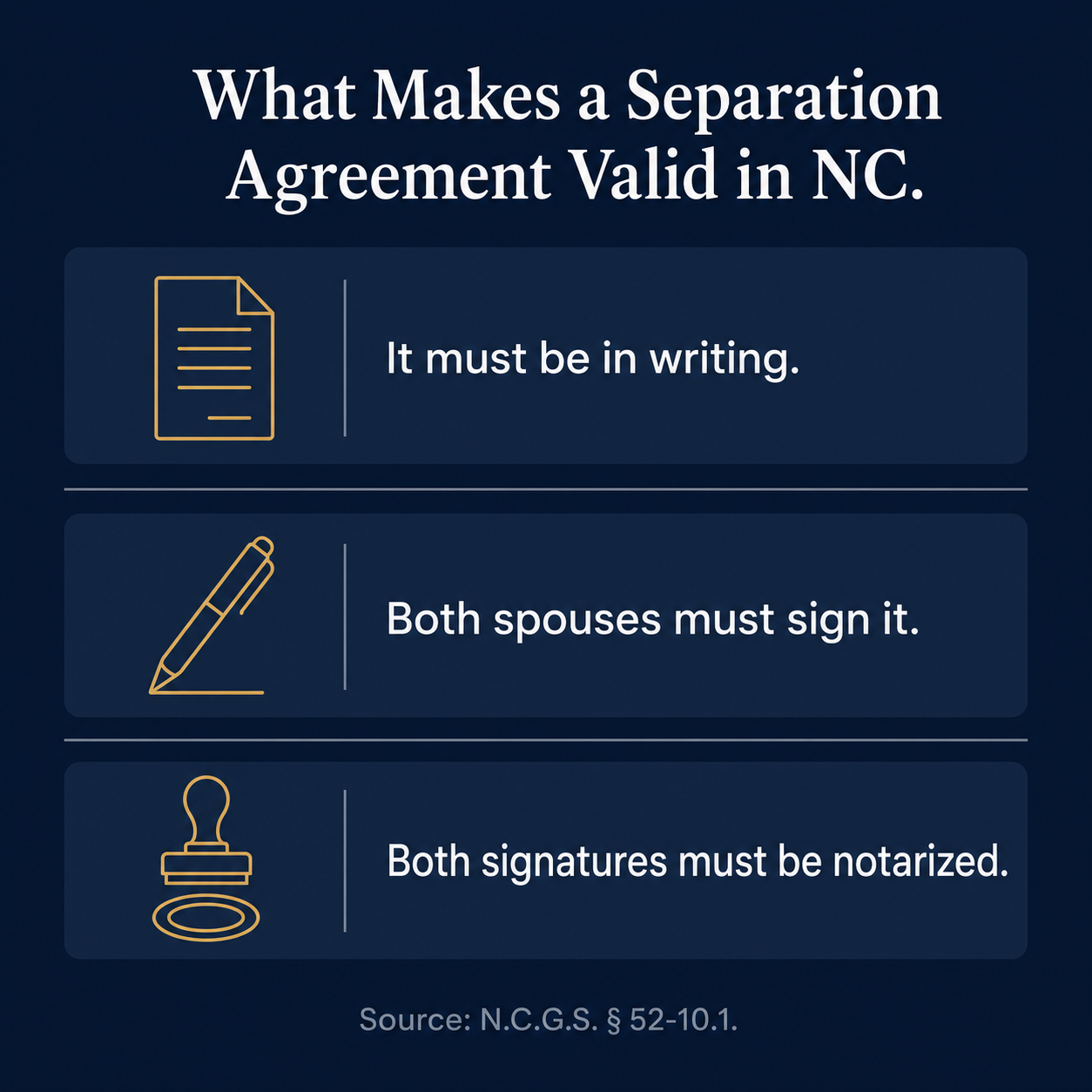
What Makes a Separation Agreement Valid in North Carolina?
The requirements are straightforward:
- It must be in writing. Verbal agreements between spouses are not enforceable as separation agreements under North Carolina law.
- Both spouses must sign it.
- Both signatures must be notarized. The statute says “acknowledged by both parties before a certifying officer.” The certifying officer cannot be either spouse.
That covers validity. No court filing is required to create the agreement. But how the agreement is used later affects how it can be enforced.
| Enforcement type | How it works |
| Unincorporated agreement (stays a private contract) | Enforced through a breach-of-contract lawsuit |
| Incorporated agreement (included in a court order or divorce decree) | Can be enforced through contempt of court |
One detail worth knowing: even if your separation agreement addresses child custody and child support, a court can later modify those terms. Custody can change if a judge finds a different arrangement is in the child’s best interest, and child support can be adjusted if circumstances substantially change. Property and spousal support terms, by contrast, are generally binding once both parties sign in an unincorporated Separation Agreement.
If you want a closer look at how agreements are structured, we publish a free sample separation agreement on our website, along with a separation agreement eCourse that walks through the process section by section.
Can One Lawyer Represent Both Spouses?
No. In North Carolina, one attorney cannot represent both spouses in preparing a separation agreement. The North Carolina State Bar’s 2019 Formal Ethics Opinion 1 addressed this directly and concluded that it is a conflict of interest that cannot be waived by consent. Even when both spouses believe they agree on everything, the State Bar says they are still legally adverse, with numerous potential points of negotiation over custody, property, and support.
In practice, the process is more nuanced. One spouse’s attorney typically drafts the agreement. The other spouse then has the option to review it with their own attorney before signing. The drafting attorney can communicate proposed terms to the other spouse and prepare documents for both signatures, but they cannot give legal advice to the unrepresented spouse beyond recommending that they get their own counsel.
This matters because some online services and templates gloss over it. If you see a service offering to draft a separation agreement “for both of you,” that is not how attorney ethics work in North Carolina. Each spouse is entitled to independent counsel.
Risks of Writing a Separation Agreement Without a Lawyer
These risks are not abstract. Here are the ways we see DIY and template agreements go wrong.
Broad release language can wipe out claims you did not realize you were giving up
Many template agreements include language where each spouse waives “any and all rights” to share in the other’s property. In Hartman v. Hartman, the North Carolina Court of Appeals enforced exactly this kind of broad release and held that it barred a later equitable distribution claim, even though specific assets were not listed in detail. If you sign a template with that language without understanding what it covers, you may be giving up your right to property division without knowing it.
What your agreement leaves out can still cost you
A separation agreement does not only bind you to the terms it includes. What it leaves out can matter just as much, and the rules differ depending on the issue.
For marital property, silence can be costly. A broad release can waive equitable distribution, as Hartman shows above, and the North Carolina State Bar’s practice guidance on separation agreements notes that leaving a disputed property item like a pension unaddressed can operate as a waiver. Separately, the right to divide marital property is lost entirely if no one asserts the claim before the absolute divorce is final.
Alimony works differently, and this is a common point of confusion. Alimony is not waived just because your agreement is silent about it. To give up alimony in a separation agreement, the waiver has to be explicit. What ends the right to alimony is finalizing the absolute divorce without an alimony claim resolved or pending. So the danger with alimony is not an accidental waiver hidden in the silence of the document; it is failing to resolve or preserve the claim before the divorce goes through.
Vague terms are effectively worthless
A clause promising to pay a “reasonable share” of college expenses sounds fair. But it does not specify what must be paid, by whom, or when. Template agreements are full of phrases like this. An attorney drafts terms that hold up in court. A template gives you words that feel reassuring but carry no weight when a dispute arises.
Notarization mistakes can undermine the entire agreement
If either signature is not properly notarized, the agreement may not be enforceable. In Lawson v. Lawson, the North Carolina Supreme Court examined whether the parties’ actions constituted a valid acknowledgment under the statute and confirmed that both writing and acknowledgment are required: the absence of either is a “fatal defect.” Getting the substance right does not help if the formalities are wrong.
You may not realize what claims expire at divorce
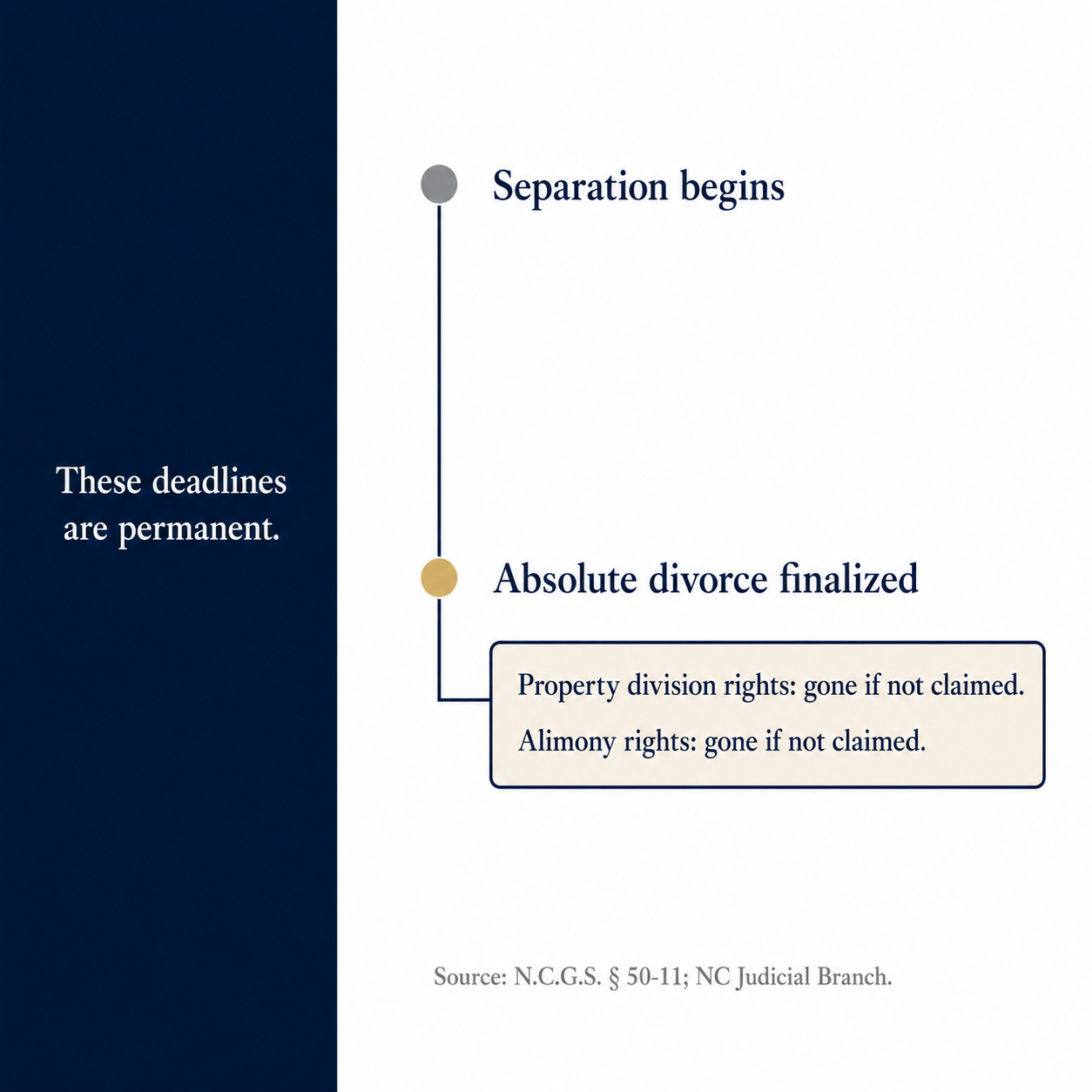
North Carolina law sets hard deadlines. If no one asserts a claim for equitable distribution before the judge signs the absolute divorce, the right to divide marital property is lost permanently. The same is true for alimony. A DIY agreement that does not properly preserve these claims, or a situation where someone skips the agreement entirely and files for divorce without knowing the consequences, can be permanently expensive.
When Is a Lawyer Most Worth It?
Not every separation needs the same level of legal involvement. Here is a general framework.
| Your situation | Level of risk | Legal help to consider |
| No shared property, no children, no support issues, both spouses agree on everything | Lower | You may be able to handle the agreement yourselves, but even a one-time attorney review can catch problems |
| Shared home, retirement accounts, or other marital assets to divide | Higher | An attorney helps protect your share of property and preserve claims before they expire |
| Children involved (custody, child support, parenting schedules) | Higher | Custody terms need to reflect what a court would find reasonable; child support should follow current NC guidelines |
| One spouse earns significantly more, or alimony is a factor | Higher | Support calculations and waivers have long-term financial consequences that are difficult to undo |
| A business, stock options, restricted stock, or complex investments | Highest | Valuation, tax consequences, and buy-out structures require both legal and financial expertise |
The Legal Aid of North Carolina divorce packet is designed for people filing an absolute divorce without a lawyer in genuinely simple situations: both spouses meet residency requirements, they have been separated at least 12 months, and neither is seeking alimony or a division of property. If your situation fits that description, self-help may work. But if there is a house, a 401(k), a business, or a support question in play, the agreement is doing real financial work. The cost of getting it wrong usually outweighs the cost of getting help.
How We Help With Separation Agreements
At Rosen Law Firm, we work with clients at every stage of the separation agreement process.
If you want us to handle the agreement from start to finish, we draft and negotiate the full separation agreement under a fixed fee set up front. You know your cost before we start, with no hourly billing and no escalating charges. For many clients, we encourage a “kitchen table” conversation with your spouse first to see how much you can work out on your own. If those conversations go well, we draft the agreement from the terms you reached. If they stall, we step in.
If you negotiated terms yourselves and want them reviewed, we can look at the agreement your spouse’s attorney drafted, or one you put together on your own, and flag anything missing, vague, or potentially harmful before you sign.
If you want to handle most of it yourselves, the firm’s DIY Divorce product gives you access to a forms library that includes separation agreement templates, with attorney support by email when you have questions.
Lisa Angel, our president and a North Carolina Board-Certified Family Law Specialist, has led the firm for more than 30 years. We practice exclusively in North Carolina family law and handle separation agreements as part of nearly every case we take. If you want help deciding how much legal support makes sense, or if you want a quote for your specific situation, contact us or call (919) 787-6668 to schedule a consultation.
For more on how separation agreements are drafted and structured, see our guide: How to Draft a Good Separation Agreement: The Nuts and Bolts.
North Carolina County Courthouse Information
| County | Address | Hours |
|---|---|---|
| Wake County | 316 Fayetteville St Raleigh NC 27601 | Monday: 8:30am-5:00pm Tuesday: 8:30am-5:00pm Wednesday: 8:30am-5:00pm Thursday: 8:30am-5:00pm Friday: 8:30am-5:00pm Saturday: Closed Sunday: Closed |
| Durham County | 510 S Dillard St Durham, NC 27701 | Monday: 8:30am-5:00pm Tuesday: 8:30am-5:00pm Wednesday: 8:30am-5:00pm Thursday: 8:30am-5:00pm Friday: 8:30am-5:00pm Saturday: Closed Sunday: Closed |
| Chatham County | 40 E Chatham St Pittsboro, NC 27312 | Monday: 8:30am-5:00pm Tuesday: 8:30am-5:00pm Wednesday: 8:30am-5:00pm Thursday: 8:30am-5:00pm Friday: 8:30am-5:00pm Saturday: Closed Sunday: Closed |
| Johnston County | 207 E Johnston St #209 Smithfield, NC 27577 | Monday: 8:00am-5:00pm Tuesday: 8:00am-5:00pm Wednesday: 8:00am-5:00pm Thursday: 8:00am-5:00pm Friday: 8:00am-5:00pm Saturday: Closed Sunday: Closed |
| Orange County | 106 E Margaret Ln Hillsborough, NC 27278 | Monday: 8:30am-5:00pm Tuesday: 8:30am-5:00pm Wednesday: 8:30am-5:00pm Thursday: 8:30am-5:00pm Friday: 8:30am-5:00pm Saturday: Closed Sunday: Closed |

Lisa is a leading figure in North Carolina’s family law field, dedicated to guiding clients through challenging times with compassion and expertise. As the President and Owner of Rosen Law Firm, P.A., Lisa has built a successful practice specializing in divorce, child custody, child support, alimony, equitable distribution, and domestic violence. She has been a North Carolina Board-Certified Specialist in Family Law since 1998.