

North Carolina does not recognize common law marriage. No matter how many years you live together, share a home, combine your finances, or introduce each other as spouses, you do not become legally married in this state. There is one exception. If you formed a valid common law marriage in another state that allows it and then moved to North Carolina, our courts will generally honor that marriage.
At Rosen Law Firm, our practice is led by a North Carolina Board-Certified Family Law Specialist, and in more than 30 years of family law work across the Triangle, this is one of the questions we hear most from unmarried couples. The short answer is simple. What it means for your property, your children, and your estate takes a little more explaining. Here is what unmarried couples in North Carolina need to know.
Does living together make you married in North Carolina?
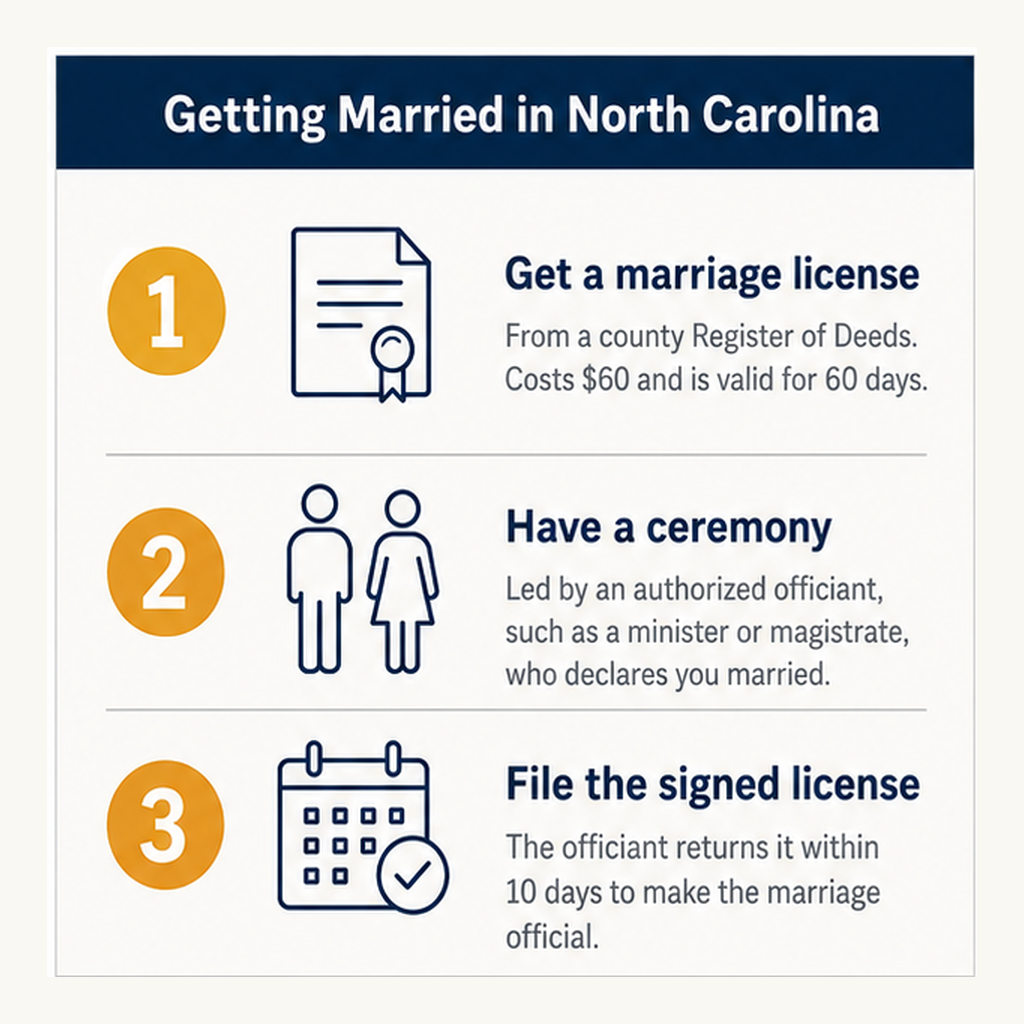
No. North Carolina only recognizes a formal, licensed marriage. Under N.C. Gen. Stat. § 51-1, a valid marriage requires two people who are legally able to marry and who agree to take each other as spouses. They have to say so in front of an official the law authorizes, such as an ordained minister or a magistrate, who then declares them married.
There is a step before the ceremony too. Under § 51-6, the couple must first get a marriage license from a county Register of Deeds. In North Carolina the license currently costs $60, stays valid for 60 days, and the officiant has to return the signed license to the Register of Deeds within 10 days after the ceremony. Living together, for any length of time, never takes the place of these steps. If you want a fuller picture of how marriage and divorce work in the state, our guide to North Carolina divorce laws is a good starting point.
The “seven-year” common law marriage myth
A lot of people believe that living together for seven years, or some other set number of years, quietly turns a relationship into a marriage. That is not true in North Carolina. The length of time you have been together carries no legal weight at all. Neither does buying a house together, sharing bank accounts, raising children, or telling everyone you are married. None of those things creates a marriage here.
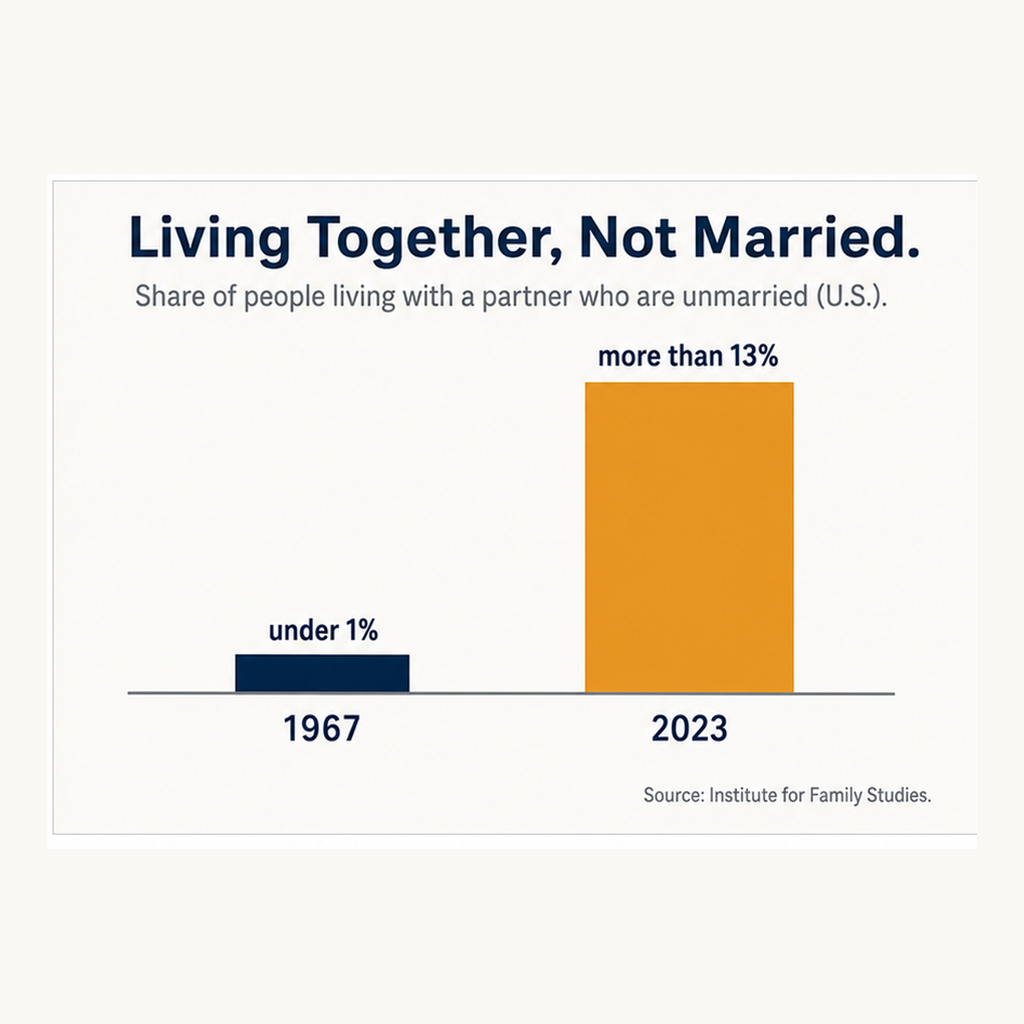
Living together without marrying is increasingly common. Nationwide, the share of people living with a partner who are not married rose from under 1% in 1967 to more than 13% in 2023, according to the Institute for Family Studies. North Carolina law still treats those couples very differently from married spouses.
Is it illegal to live together in North Carolina?
Not in any practical sense. There is an old law on the books, N.C. Gen. Stat. § 14-184, dating to 1805, that makes it a Class 2 misdemeanor for an unmarried couple to “lewdly and lasciviously” live together. In 2006, a North Carolina Superior Court judge held the statute unconstitutional in Hobbs v. Smith, an unpublished Pender County decision that relied on the U.S. Supreme Court’s ruling in Lawrence v. Texas, 539 U.S. 558 (2003). Because that order came from a trial court rather than an appellate court, the statute technically remains in the General Statutes. In practice it is not enforced, and unmarried couples live together across the state without any legal risk. The statute is mainly a reminder of how firmly North Carolina has always tied legal rights to a formal marriage.
When North Carolina recognizes an out-of-state common law marriage
North Carolina will recognize a common law marriage if it was validly formed in a state whose laws allow it. States generally honor marriages that were valid where they were created, so a couple who met the legal requirements for common law marriage in a state like Texas, and then moved here, stays married in North Carolina’s eyes.
The North Carolina Court of Appeals applied this rule in Garrett v. Burris, 224 N.C. App. 32, 735 S.E.2d 414 (2012), where the court looked to the other state’s law to decide whether a marriage existed. That case also shows the claim is not automatic. You have to prove the marriage actually met the other state’s specific requirements, and courts weigh the evidence closely. In Garrett, real estate documents that listed one partner as “unmarried” counted against the claim that the couple was married.
Only a handful of states still allow a couple to form a new common law marriage. Others recognize one only if it was created before a cutoff date.
| States that still allow new common law marriages | States that recognize only older ones (formed before a cutoff) |
| Colorado | Alabama (before 2017) |
| Iowa | Florida (before 1968) |
| Kansas | Georgia (before 1997) |
| Montana | Idaho (before 1996) |
| Rhode Island | Indiana (before 1958) |
| Texas | Ohio (before 1991) |
| Utah | Pennsylvania (before 2005) |
| Washington, D.C. | South Carolina (before July 24, 2019) |
State laws change, so confirm the current rule in the state where you believe your marriage was formed. South Carolina, which borders North Carolina, ended new common law marriages in 2019 in Stone v. Thompson, 428 S.C. 79, 833 S.E.2d 266 (2019), where the South Carolina Supreme Court abolished the doctrine going forward. Couples who formed one there before July 24, 2019 are still married, but they now have to prove it by a higher standard of evidence.
What are unmarried couples’ rights when they separate in North Carolina?
This is where not being married matters most. When married couples divorce, N.C. Gen. Stat. § 50-20(a) directs the court to determine what is marital and divisible property and to distribute it, and § 50-20(c) calls for an equal division unless the court finds that an equal division would not be equitable. That happens regardless of whose name is on the title. Unmarried couples get none of that. If you separate, property goes to whoever holds legal title or can prove they paid for it. There is also no alimony, and no “palimony,” between unmarried partners.

Here is what that looks like in practice. A partner who spent years helping pay the mortgage on a home titled only in the other partner’s name has no automatic claim to the equity. If you own a home together as tenants in common, family court cannot divide it for you. You would have to file a partition action with the Clerk of Superior Court to force a sale or a buyout.
North Carolina courts do allow unmarried partners to bring some claims under general contract and equity rules. In Suggs v. Norris, 88 N.C. App. 539, 364 S.E.2d 159 (1988), the Court of Appeals recognized that a partner can pursue remedies like a resulting trust, a constructive trust, or payment for the reasonable value of services provided. These claims are hard to prove, depend heavily on the facts, and are far less predictable than the property division that married couples receive. That gap is the main reason unmarried couples benefit from putting agreements in place ahead of time.
Do unmarried parents have custody and child support rights?
Yes. A parent’s marital status has nothing to do with custody or child support. Both parents can seek custody, and both owe support under the North Carolina Child Support Guidelines, whether or not they were ever married.
The one added step for unmarried parents is establishing legal parentage. This usually happens by signing an affidavit of parentage at the hospital when the child is born, or later through a court order for paternity. Once parentage is established, an unmarried parent has the same rights and responsibilities as any other parent. We often help never-married parents put a clear arrangement in place, whether that involves child custody or child support.
What happens if an unmarried partner dies or becomes incapacitated?
Without the right documents in place, an unmarried partner is treated as a legal stranger. If your partner dies without a will, North Carolina’s intestacy laws pass the estate to the closest blood relatives. Under § 29-15, the estate goes to the intestate’s children and their descendants first, then to surviving parents, then to brothers and sisters and their descendants, with the individual shares set by § 29-16. A surviving unmarried partner inherits nothing and cannot claim the elective share that protects a surviving spouse under N.C. Gen. Stat. § 30-3.1.
The same problem shows up during a medical crisis. If your partner is incapacitated and cannot make decisions, you have no automatic authority over their care. That authority falls to their family members unless your partner named you in a health care power of attorney. These are estate planning matters rather than family law, so an estate planning attorney is the right person to set up a will, powers of attorney, and beneficiary designations.
How can unmarried couples protect themselves in North Carolina?
Because state law gives unmarried partners so little by default, protection comes from setting up agreements and documents while the relationship is healthy. The tools below cover the most common gaps.
| Protection | What it does |
| Cohabitation agreement | A written contract that spells out how you will divide property, debt, and expenses if you separate. North Carolina enforces these under Suggs v. Norris, as long as the agreement is not based on sexual services. |
| Will | Directs where your property goes, so your partner is not shut out by the intestacy laws. |
| Health care power of attorney | Lets your partner make medical decisions for you if you cannot. |
| Durable (financial) power of attorney | Lets your partner manage your finances if you become incapacitated. |
| Updated beneficiary designations | Sends life insurance and retirement accounts directly to your partner. |
| Joint title with right of survivorship | Lets jointly owned property pass to the surviving partner outside of probate. |
A family law attorney can help with a cohabitation agreement, and, for parents, with a custody and support arrangement. A will and powers of attorney are usually handled by an estate planning attorney. Putting these pieces in place early is far easier than trying to sort things out after a separation or a death.
Talk with a North Carolina family law attorney
If you are living with a partner and want to understand where you stand, or you want to put the right protections in place, we are glad to help. Our firm has focused on North Carolina family law for more than 30 years, and we work on a fixed fee set up front, so you know your cost from the start. If you have children together, we can help you set up a custody and support arrangement, and we can walk you through the steps to protect yourself and your property. When you are ready, you can take the next step and reach out to us.
This article is general information about North Carolina law and is not legal advice. Outcomes depend on the specific facts of each case.

Lisa is a leading figure in North Carolina’s family law field, dedicated to guiding clients through challenging times with compassion and expertise. As the President and Owner of Rosen Law Firm, P.A., Lisa has built a successful practice specializing in divorce, child custody, child support, alimony, equitable distribution, and domestic violence. She has been a North Carolina Board-Certified Specialist in Family Law since 1998.